TL;DR
- In Herriman’s 84096, the median home was built in 2011 and about 87% of housing units date from 2000 or later (ACS 2020–2024). With young systems, uneven floors are usually a balancing, duct, or design question, not a worn-out furnace.
- Warm air rises, one thermostat reads one floor, and ducts lose air: ENERGY STAR says a typical house loses 20–30% of duct air to leaks.
- Safe checks: open registers, clear return grilles, change the filter, and don’t close vents to push air around (DOE says that can cut airflow through the air handler).
- If one duct trunk feeds each floor, DOE’s Building America Solution Center describes a seasonal damper setting: less air upstairs in winter, more in summer.
- Bigger fixes (returns, duct sealing, zoning, a second system, ductless) are for a licensed shop. Herriman requires a permit to replace or add a furnace or AC; repair and maintenance don’t need one.
It’s a familiar complaint in two-story homes: the bedrooms upstairs are stuffy in July, and the main floor or basement feels cool in January, all on one thermostat. It isn’t always a broken part. Warm air rises, ducts and returns may not move air where it’s needed, and one system is trying to satisfy floors with very different loads. This guide explains what DOE and ENERGY STAR say about it, the checks that are safe for you, and the fixes a licensed shop may suggest, from simple balancing to zoning.
Utah HVAC Connect is a matchmaker under Apex Lead Group, LLC. We connect Herriman homeowners with licensed Utah HVAC contractors. We’re not a contractor, we don’t diagnose, and we don’t quote.
Why this comes up so often in Herriman
Herriman’s housing is young. In ZIP 84096, the median home was built in 2011; 46% of the 22,467 housing units were built from 2010 to 2019 and another 10% in 2020 or later, so about 87% date from 2000 or later. About 65% of units are single-family detached homes and 19% are single-family attached, such as townhomes (ACS 2020–2024, tables B25034, B25035, B25024). The city added about 3,756 housing units between April 2020 and July 2025, from 16,277 to 20,033 (Gardner Policy Institute / Utah Population Committee).
One honest limit: the Census doesn’t publish how many homes are two-story, so we can’t tell you how common the problem is. What the data does say is that most Herriman systems are young, so uneven temperatures are more often a design, balancing, or duct question than a worn-out furnace.
The swing is seasonal. At the Salt Lake City airport, NOAA’s 1991–2020 normals show cooling demand peaking in July (500 cooling degree days) and August (441), and heating demand peaking in December (1,018 heating degree days) and January (1,041) (NOAA monthly normals). Herriman isn’t at the airport, so treat those as a regional guide, not a reading for your street.
Why upper floors run hot and lower floors run cool
- Warm air rises. DOE’s Building America HVAC guide describes the “stack effect” in two-story houses: warm air moves up and out through upper openings, the way air rises in a chimney (DOE Building America HVAC guide).
- Ducts and returns. DOE’s Building America Solution Center lists temperature differences between rooms among the symptoms of pressure imbalances, and says poor circulation is sometimes caused by the lack of a properly sized return air path back to the air handler (DOE BASC). ENERGY STAR says a typical house loses about 20 to 30 percent of the air moving through its ducts to leaks, holes, and poor connections, which makes rooms hard to heat and cool, and that ducts in an attic, crawlspace, or garage are a warning sign (ENERGY STAR).
- Insulation and air leaks. ENERGY STAR lists “hot and cold rooms; uneven temperature between rooms” as a common problem tied to the attic, the basement, and the ducts (ENERGY STAR), and says improper equipment operation, duct problems, or inadequate insulation could be the cause (ENERGY STAR).
- One thermostat. A single-zone system responds to the temperature where the thermostat is. If that’s on the main floor, the system can be satisfied there while upstairs is still warm.
Checks that are safe for you
- Open every supply register and move furniture, rugs, and storage off return grilles. BASC specifically says to make sure furniture or storage isn’t blocking a return grille low on a wall (BASC).
- Don’t close vents to “push” air somewhere else. DOE’s HVAC guide says shutting vents in unused rooms isn’t recommended because it can reduce airflow through the air handler, create pressure imbalances, and stress duct connections (DOE).
- Leave bedroom doors open for a day and see if the rooms even out. BASC says bedrooms need door undercuts, a transfer grille, or a jump duct so air can get back to the return when doors are closed (BASC). If open doors help, that’s useful information for a shop.
- Replace the filter. A clogged filter cuts airflow everywhere. For more on what a restricted filter does, see our cold-air guide.
- Look for trunk dampers. Some homes have one supply trunk for each floor, each with a manual damper handle near the furnace. If yours does, see the next section before you touch it.
The seasonal damper setting
DOE’s Building America Solution Center calls manual balancing dampers in the supply trunks “a common solution for two-story houses where one trunk serves the first floor and another trunk serves the second floor,” and says they allow seasonal adjustment: less air upstairs during the heating season and more air upstairs during the cooling season (BASC).
Two cautions from the same source. Dampers fine-tune airflow; they don’t fix ducts that were sized wrong. And too many closed dampers can starve the furnace or air handler of airflow, which can make the equipment malfunction and, in cooling season, ice up the evaporator coil. If you’re not sure which handle does what, have a licensed shop set it and mark the summer and winter positions.
Fixes a licensed shop may suggest
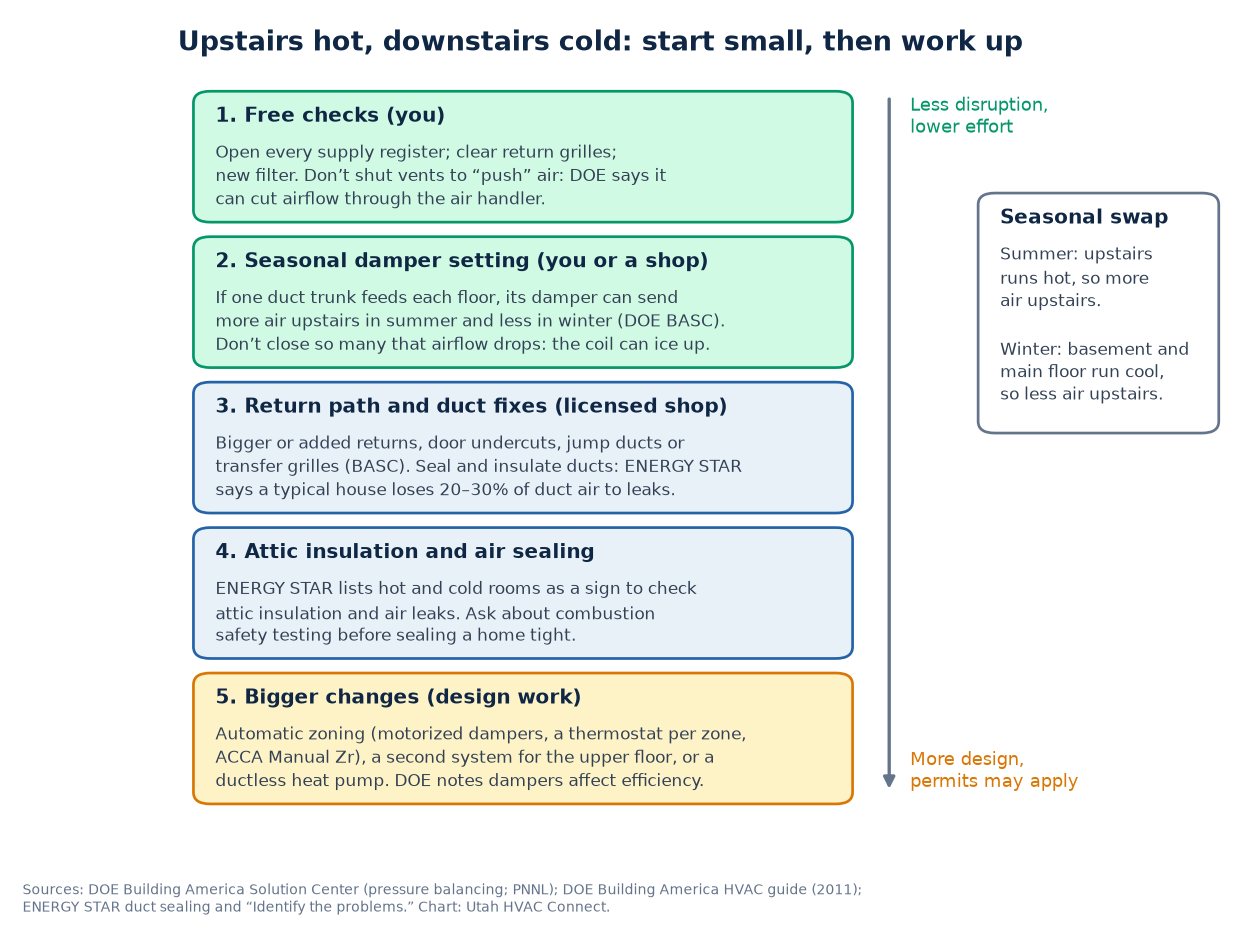
Roughly in order from least to most involved:
- Air balancing. Adjusting branch or trunk dampers, or adding self-adjusting airflow regulators at registers where dampers are missing or buried behind finished ceilings (BASC).
- A better return path. Enlarging an undersized return grille or duct, adding a second return, or adding transfer grilles or jump ducts for closed bedrooms. BASC points to ACCA Manual D for sizing (BASC).
- Duct sealing and insulation. ENERGY STAR recommends mastic sealant or metal tape (never cloth duct tape) and insulating ducts in attics, crawlspaces, unfinished basements, and garages, and notes that most heating and cooling contractors also repair ductwork (ENERGY STAR). A duct leakage test can show whether sealing is worth it (BASC).
- Attic insulation and air sealing. Often done by an insulation or home-performance contractor rather than an HVAC shop. ENERGY STAR warns that sealing a home can cause combustion appliances such as water heaters to backdraft, and recommends inspection and testing for combustion safety first (ENERGY STAR).
- Automatic zoning. Motorized dampers with a thermostat for each zone, designed per ACCA Manual Zr, can help when one balancing setting can’t work for every season (BASC). DOE notes that damper zoning affects system efficiency and balance, and that dampered zoning can bring noise and trouble maintaining airflow over the cooling coil (DOE).
- A second system or a ductless heat pump. DOE’s guide says zoning in large homes is more commonly, and more effectively, done with multiple systems, one per floor, and that ductless heat pumps can provide efficient zoned heating and cooling (DOE).
If the AC is near the end of its life anyway (ENERGY STAR suggests considering replacement once an AC or heat pump is more than 10 years old), the comfort problem and the replacement are worth discussing together, including whether a heat pump or dual fuel fits. Our AC and heat pump replacement guide covers the options and 2026 Utah rebates.
Herriman permits: what needs one
Herriman’s building department says repair and maintenance of existing heating and air-conditioning systems don’t require a permit, but replacing or adding a new furnace or air conditioner does (see furnace replacement and AC replacement questions), and so does adding new mechanical lines to a home. If you replace a furnace and an AC at the same time, they can go on one permit, and an inspection is required when the work is done (Herriman, Electrical/Mechanical/Plumbing permits). Ask your contractor whether your scope (new ducts, a second system, a ductless unit) needs a permit and whether it’s in the bid. Riverton and Bluffdale addresses go through their own cities; see our Riverton & Herriman page.
Questions to ask the shop
- Will you measure airflow or pressure at the registers and returns, not just look at the equipment? (BASC describes pressure testing as part of a whole-house assessment.)
- Does my house have trunk or branch dampers, and can you mark the summer and winter settings?
- Is the return path big enough for the upstairs? Would transfer grilles or jump ducts help the bedrooms?
- Are any ducts in the attic or garage, and are they sealed and insulated? Is a duct leakage test worth doing?
- If you recommend zoning or a second system, was it designed from a room-by-room load calculation (ACCA Manual J) and the zoning manual (Manual Zr)?
- Does any of this need a Herriman permit, and is it in the price?
Heat completely out instead of uneven? That’s a different problem: start with no-heat help.
How matching works
- Tell us what you need on the free Get Help form: service type (Repair, Install, or “I’m not sure”), urgency (Today, This week, or Planning), your ZIP, and when it’s reasonable to reach you.
- We match licensed Utah shops that serve your ZIP. We don’t dispatch technicians, diagnose, or write proposals.
- Matched pros may reach out using the contact details you provide. You talk with them, compare, and hire who you want, or no one. No homeowner fee and no obligation. More: how it works and how we make money.
Related guides
- AC and heat pump replacement in Utah: if the AC is due anyway, compare AC-only, dual fuel, and all-electric
- Furnace and AC help in Riverton, Bluffdale & Herriman: local housing data and permit offices
- Why is my furnace blowing cold air? The causes furnace makers list
- Furnace not working? No-heat help in Utah
- West Jordan & South Jordan: another area with many 2000s and 2010s homes
- Builder-grade furnace warranty: what to check before paying for a repair in a newer home
- What drives HVAC costs in Riverton and Herriman homes: if zoning or a new system comes up in a bid
How we put this page together
This page was written by the Utah HVAC Connect editorial team, not by a contractor. We used public data only: NOAA 1991–2020 climate normals, U.S. Census Bureau American Community Survey (ACS) estimates, and the rebate, permit, and licensing pages published by Utah utilities, cities, and DOPL, each checked on the date shown above. For this article we pulled ZIP-level housing data and city housing-unit estimates, and read DOE Building America and ENERGY STAR guidance on duct balancing, zoning, and duct sealing, plus Herriman’s own permit page. We don’t publish prices we can’t source, contractors can’t pay to be mentioned here, and we don’t name partner shops on this page. Programs and rules change, so confirm details with the program or your contractor before you sign anything. See our editorial policy. Spot an error? Email hello@utahhvacconnect.com.
Sources
- U.S. Census Bureau, ACS 2020–2024 5-year, tables B25034, B25035, B25003, B25024, ZCTA 84096, via Census Reporter API
- Census Reporter profile, ZCTA 84096
- Kem C. Gardner Policy Institute / Utah Population Committee, 2025 subcounty dataset (housing units, April 2020 to July 2025)
- NOAA NCEI, 1991–2020 monthly normals (heating and cooling degree days), Salt Lake City Intl Airport
- U.S. DOE Building America Solution Center (PNNL), Pressure balancing supply and return ducts in existing homes
- U.S. DOE Building America Solution Center (PNNL), Pre-retrofit assessment of existing HVAC systems
- U.S. DOE, Building America Best Practices Series Vol. 14, Energy Renovations: HVAC (PNNL/ORNL, 2011), sections on zoning and the stack effect
- ENERGY STAR, Duct sealing
- ENERGY STAR, Identify the problems you want to fix
- ENERGY STAR, When is it time to replace?
- Herriman City, Electrical/Mechanical/Plumbing permits
- Herriman City, Building Permits
Questions about the service: hello@utahhvacconnect.com.
FAQ
Why is my upstairs so hot and my downstairs so cold?
In two-story homes, warm air rises (the stack effect), and one thermostat responds only to the temperature where it sits. Duct and return problems add to it: DOE’s Building America Solution Center lists temperature differences between rooms among the symptoms of pressure imbalances, and ENERGY STAR says a typical house loses 20 to 30 percent of duct air to leaks.
Should I close the vents downstairs to push air upstairs?
DOE’s Building America HVAC guide says shutting vents isn’t recommended, because it can reduce airflow through the air handler, create pressure imbalances, and stress duct connections. If your home has a damper for each floor’s trunk, adjusting that seasonally is the approach DOE’s Solution Center describes.
How do I balance airflow between floors?
If one duct trunk serves each floor, manual trunk dampers can send less air upstairs in the heating season and more in the cooling season. Don’t close so many dampers that airflow drops; that can make the equipment malfunction and ice the cooling coil. A licensed shop can set and mark the positions.
Is HVAC zoning worth it for a two-story house?
It can help when one balancing setting doesn’t work across seasons. DOE notes damper zoning affects efficiency and balance and can bring noise and coil-airflow issues, and says large homes are often zoned more effectively with one system per floor or ductless heat pumps. A licensed shop should design it from a load calculation.
Do I need a permit in Herriman to fix uneven temperatures?
Herriman says repair and maintenance of existing heating and AC systems don’t need a permit, but replacing or adding a furnace or air conditioner does, as does adding new mechanical lines. Ask your contractor whether your specific scope needs one.
Can Utah HVAC Connect fix it?
No. We’re a free matchmaker. You send a request, and licensed Utah HVAC shops that serve your ZIP may reach out. We don’t diagnose, install, or quote.