TL;DR
- Inversions trap fine particles (PM2.5) under warm air. Utah DEQ says a typical winter brings five to six multi-day episodes.
- Our count of EPA data, 2023–2025: fine particles set a Moderate-or-worse AQI on about 45 days a year from November through January in Salt Lake County; summer’s bad-air days were mostly ozone.
- EPA recommends at least MERV 13, or as high as your system fan and filter slot can accommodate. Ask an HVAC tech what yours can take.
- The catch: a filter that’s too restrictive can cut airflow. Low airflow can trip the furnace’s high-limit switch and leave you with cool air.
- If your system can’t take MERV 13, EPA suggests a portable air cleaner sized by CADR. On mandatory no-burn days, wood and pellet stoves are off-limits.
Every winter, the Salt Lake Valley and Utah Valley get inversions: cold air pinned under a lid of warmer air, holding pollution near the ground for days. A better furnace filter is one thing you can control. It can help, but a filter that’s too restrictive for your system can also cut airflow, and low airflow is one of the classic reasons a furnace shuts its burners off and blows cool air. This guide explains what an inversion is, what three years of EPA data show about our bad-air days, what EPA actually recommends for filters, and where the airflow catch comes in.
Utah HVAC Connect is a matchmaker. We connect homeowners with licensed Utah HVAC contractors; we’re not a contractor, we don’t sell filters, and we don’t quote. This page isn’t medical advice. If air quality affects your health, talk to your doctor.
What an inversion is
Normally, air near the ground is warmer than the air above it and the two mix. In an inversion the pattern flips: cold air at the surface gets trapped under warmer air. Utah DEQ says inversions often follow a snowstorm, when snow cover chills the air near the ground and a high-pressure system settles in “much like a lid over the valley bowl.” The Wasatch and Oquirrh Mountains and Traverse Mountain form a basin that traps the cold air in the Salt Lake Valley (Utah DEQ).
- DEQ says a typical Utah winter sees about five to six multi-day inversion episodes and, on average, 18 days with fine-particle (PM2.5) levels above the federal standard.
- Most of that PM2.5 isn’t emitted directly. It forms in the air from gases such as nitrogen oxides, VOCs, sulfur dioxide, and ammonia, and DEQ says secondary ammonium nitrate is responsible for up to 70% of the particle mass during inversions.
- A strong storm or low-pressure system is often what finally clears it out (Utah DEQ).
What the last three years looked like
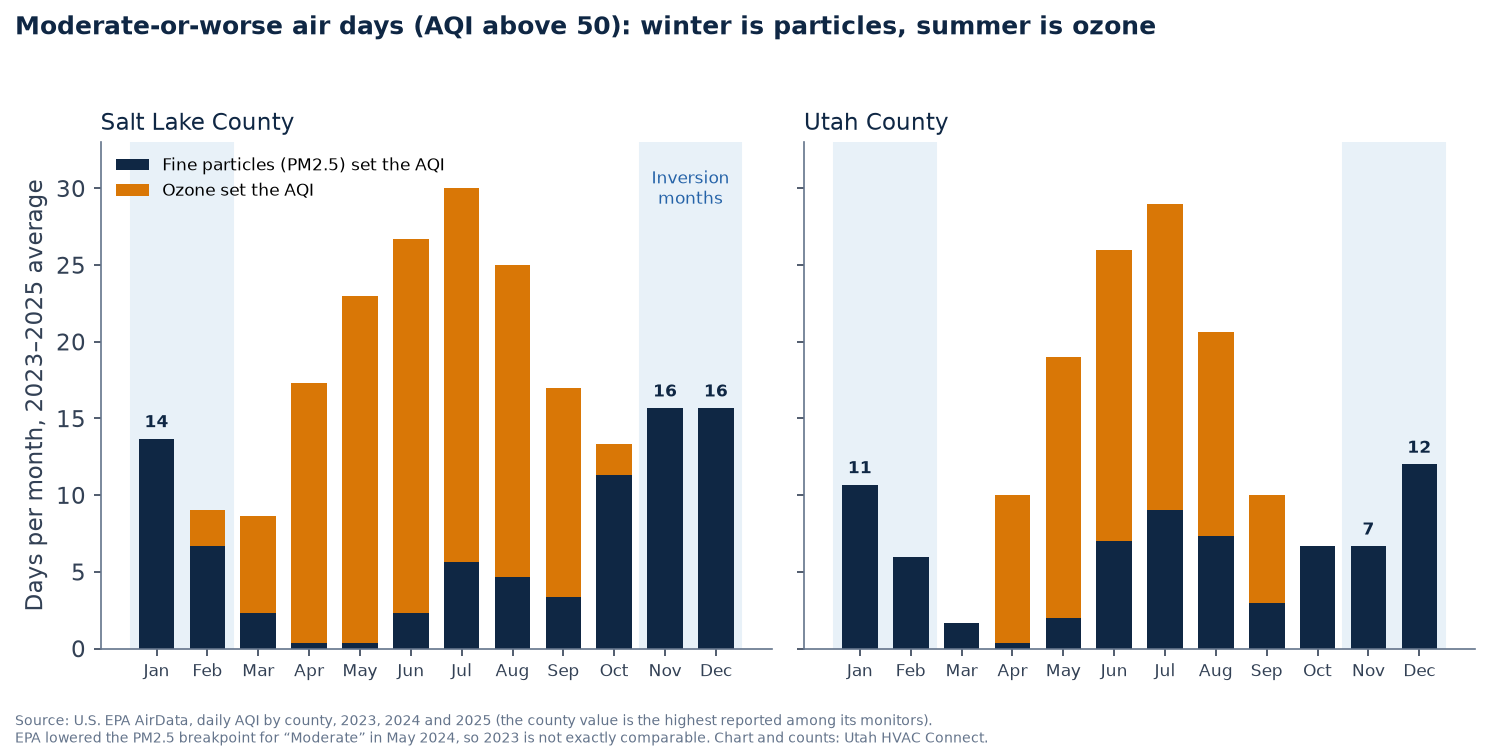
We counted every day from 2023 through 2025 in EPA’s daily county Air Quality Index files for Salt Lake and Utah counties, and noted which pollutant set the index that day (EPA AirData). Two things stand out:
- Winter bad-air days are particle days. In Salt Lake County, fine particles set a “Moderate or worse” index on about 45 days a year from November through January, roughly half of those three months. In Utah County it was about 29 days. Ozone set the index on almost none of those days.
- Summer bad-air days are mostly ozone. From April through September the pattern flips. That matters for filters: furnace and HVAC filters for homes are usually designed to capture particles, and EPA notes that filtering gases takes a different kind of filter, such as activated carbon (EPA Guide to Air Cleaners in the Home).
The worst days were rarer. Counting days above 100 (“Unhealthy for Sensitive Groups” or worse) set by fine particles from December through February, Salt Lake County had 9 across the three years and Utah County had none. That’s well below DEQ’s typical-winter average, but three mild-ish winters don’t predict this one, so check the daily forecast rather than the calendar.
Two caveats. EPA’s county value is the highest reading among that county’s monitors, not your street. And in May 2024 EPA lowered the PM2.5 level where “Moderate” starts to 9.1 µg/m³ (EPA AQI breakpoints), so 2023 counts aren’t exactly comparable with later years (Federal Register, 2024 PM rule).
What EPA recommends for furnace filters
EPA’s advice is specific: if you upgrade, choose a filter rated at least MERV 13, or as high a rating as your system fan and filter slot can accommodate, and you may need an HVAC professional to tell you what your system can take (EPA). MERV 13 must catch at least half of the smallest particles in the test:
| MERV | Particles 0.3–1.0 µm | Particles 1.0–3.0 µm | Particles 3.0–10.0 µm |
|---|---|---|---|
| 8 | not rated | at least 20% | at least 70% |
| 11 | at least 20% | at least 65% | at least 85% |
| 13 | at least 50% | at least 85% | at least 90% |
| 16 | at least 95% | at least 95% | at least 95% |
Average capture efficiency by particle size, from EPA, What is a MERV rating? (selected rows). PM2.5 means particles 2.5 µm and smaller, so the first two columns are the ones that matter in an inversion.
Three more points from EPA that often get missed:
- The filter only works when the blower runs. EPA says home HVAC systems usually run less than 25% of the time during heating and cooling seasons. Running the fan longer filters more air but raises electricity costs (EPA). One trade-off to know: with the fan set to “On,” the blower moves room-temperature air between heating cycles, which is the most common “cold air” complaint we cover in why a furnace blows cold air.
- Fit matters. The filter should fit snugly so air doesn’t leak around it, without bending or crushing it (EPA).
- A heat pump doesn’t change the math. If your home has a ducted heat pump, EPA says the forced-air system as a whole decides whether it can take a high-efficiency filter (EPA).
The airflow catch
A denser filter can mean more resistance to airflow. EPA’s technical summary says resistance “generally, but not necessarily” rises with MERV for a filter of the same thickness, because makers often reach higher ratings with deeper pleats and thicker filters instead. It also says any high-efficiency furnace filter has to be compatible with the existing ducted system “to ensure that airflow will not be impeded,” and that a trained professional may need to modify the system to fit one (EPA, Residential Air Cleaners).
Furnace manuals say the same thing from the other side. Lennox’s homeowner manual for its EL195 furnace says to use replacement filters similar in size and efficiency to the ones the installer provided, warning that higher-rated filters “may restrict air flow,” reducing efficiency and risking premature blower motor failure (Lennox manual). Your brand’s manual may say something different. Read yours.
Why it matters in January: when airflow drops too far, the furnace’s high-limit switch shuts the burners off to protect the heat exchanger while the blower keeps running. That’s why a choked filter so often shows up as “cold air” (Carrier). And a filter loaded with dirt loses performance too, because air either slows down or bypasses it (EPA). So the inversion-season rule is simple: the right rating for your system, changed on schedule.
What to do before and during inversion season
- Find your filter slot. Note the size printed on the current filter and how thick the slot is. A thin 1-inch slot and a deeper media-filter cabinet are different conversations, since EPA notes makers often reach high ratings with deeper filters.
- Check your manual for a filter rating or airflow note, as Lennox’s does.
- Ask a licensed HVAC tech what the highest-rated filter your fan and slot can handle is, which is the question EPA tells homeowners to ask. If the answer is below MERV 13, ask whether a deeper filter cabinet makes sense for your system.
- Change it on schedule. Follow the maker’s interval. EPA says a dirty, overloaded filter won’t work well (EPA).
- If the system can’t take MERV 13, EPA suggests a portable air cleaner, sized by its clean air delivery rate (CADR). EPA’s rough guide is a CADR of at least 130 for a 200 sq ft room and 260 for 400 sq ft, assuming 8-foot ceilings (EPA).
- Know the burn rules. On mandatory no-burn days, Utah DAQ prohibits wood fireplaces, wood and pellet stoves, and coal stoves in all of Salt Lake and Davis counties, Utah and Weber counties west of the Wasatch, the Cache Valley, and parts of Box Elder and Tooele counties. Natural gas appliances are allowed. DAQ says these days are typically called from November 1 to March 1 (Utah DAQ).
If the furnace starts cycling off or blowing cool air after a filter change, put the old style back and see our no-heat checklist or why a furnace short-cycles.
What to tell a shop
- The filter size and rating you’re using now, and when you changed it.
- Whether the problem started after a filter upgrade.
- What the furnace does: shuts off and restarts, blows cool air, or shows a blinking code.
- Whether you’d like them to check whether the system can take a higher-rated or deeper filter.
Check the license before work starts
Before anyone works on your system, look the company up on DOPL’s free Licensee Lookup & Verification. You want an Active status and an HVAC classification (H100, or the older S350), under the same business name that’s on your estimate. Step-by-step: how to check a Utah HVAC license.
How matching works
- Tell us what you need on the free Get Help form: service type (Repair, Tune-up, or “I’m not sure”), urgency (Today, This week, or Planning), your ZIP, and when it’s reasonable to reach you.
- We match licensed Utah shops that serve your ZIP. We don’t dispatch technicians, diagnose, or write proposals.
- Matched pros may reach out using the contact details you provide. You talk with them, compare, and hire who you want, or no one. No homeowner fee and no obligation. More: how it works and how we make money.
Related guides
- Furnace not working? No-heat help in Utah: safety first, then basic checks
- Why is my furnace blowing cold air?: nine causes and who handles each
- Why is my furnace short-cycling?: overheating, flame sensors, and sizing
- West Jordan & South Jordan: local data for the Salt Lake Valley’s west side
- Provo & Orem: local data for Utah Valley
How we put this page together
This page was written by the Utah HVAC Connect editorial team, not by a contractor. We used public data only: NOAA 1991–2020 climate normals, U.S. Census Bureau American Community Survey (ACS) estimates, and the rebate, permit, and licensing pages published by Utah utilities, cities, and DOPL, each checked on the date shown above. For this article we downloaded EPA’s daily county AQI files for 2023, 2024 and 2025 and counted the days for Salt Lake and Utah counties ourselves, by month and by the pollutant that set the index. We read Utah DEQ’s inversion and no-burn pages, EPA’s filter and air-cleaner guidance including its technical summary, and a furnace maker’s homeowner manual. We don’t publish prices we can’t source, contractors can’t pay to be mentioned here, and we don’t name partner shops on this page. Programs and rules change, so confirm details with the program or your contractor before you sign anything. See our editorial policy. Spot an error? Email hello@utahhvacconnect.com.
Sources
- Utah Department of Environmental Quality, Inversions
- Utah Division of Air Quality, Mandatory no burn days
- U.S. EPA AirData, daily AQI by county, 2023, 2024 and 2025 (download files)
- U.S. EPA Air Quality System, AQI breakpoints
- Federal Register, Reconsideration of the National Ambient Air Quality Standards for Particulate Matter (March 6, 2024)
- U.S. EPA, What is a MERV rating?
- U.S. EPA, Guide to Air Cleaners in the Home
- U.S. EPA, Do ducted air source heat pumps filter fine particles out of indoor air?
- U.S. EPA, Residential Air Cleaners: A Technical Summary, 3rd edition (PDF)
- Lennox, EL195NE homeowner manual (PDF)
- Carrier, furnace blowing cold air
- Utah DOPL, Licensee Lookup & Verification
Questions about the service: hello@utahhvacconnect.com.
FAQ
What MERV filter should I use during a Utah inversion?
EPA recommends at least MERV 13, or as high a rating as your system fan and filter slot can accommodate. MERV 13 must capture at least 50% of particles from 0.3 to 1.0 microns. Ask an HVAC technician what your system can take.
Can a high-MERV filter hurt my furnace?
It can if your system wasn’t built for it. EPA says a high-efficiency filter has to be compatible with the ductwork so airflow isn’t impeded, and Lennox’s EL195 manual warns that higher-rated filters may restrict airflow and shorten blower motor life. Low airflow can also trip the furnace’s high-limit switch.
Does a furnace filter help with summer ozone?
Not much. EPA says home furnace and HVAC filters are usually designed to capture particles. Filtering gases takes a different filter, such as activated carbon. Our count of EPA data shows most of Salt Lake County’s summer bad-air days were ozone days.
How many bad-air days does Salt Lake County get in winter?
From 2023 through 2025, fine particles pushed Salt Lake County’s AQI above 50 on about 45 days a year from November through January. Days above 100 were rarer: 9 from December through February across the three years. DEQ says a typical winter averages 18 days above the federal PM2.5 standard.
Should I run my furnace fan all the time during an inversion?
EPA says filters only clean air when the blower runs, and longer run times filter more air but use more electricity. With the fan on “On,” the blower also pushes room-temperature air between heating cycles, which can feel like cold air. It’s a trade-off, not a rule.
Can I use my fireplace during an inversion?
Not on a mandatory no-burn day. Utah DAQ prohibits wood fireplaces, wood and pellet stoves, and coal stoves in the covered areas on those days. Natural gas appliances are allowed.
Do you sell filters or service furnaces?
No. We’re a matchmaker: we connect homeowners with licensed Utah HVAC shops that serve their ZIP. We don’t sell equipment, diagnose, or quote. The request is free, with no obligation to hire.