TL;DR
- Short-cycling means the furnace turns on and off in cycles that are often under 5–10 minutes (Carrier). When it shuts off is the clue.
- Flame out within 2–5 seconds points to the flame sensor (a shop job). Burners stopping after a few minutes while the fan runs points to overheating: check the filter, vents, and returns first.
- Short, frequent full cycles can mean an oversized furnace or a badly placed thermostat. DOE says many older and even replacement furnaces are oversized from rule-of-thumb sizing.
- West Jordan’s ZIPs differ: median homes date to 1985 (84084), 1993 (84088), and 2004 (84081), so sizing questions fit the older east side and warranty questions the newer west side (ACS 2020–2024).
- Free match request; licensed shops that serve your ZIP may reach out. No diagnosis or prices here.
A furnace that short-cycles turns on, runs briefly, shuts off, and starts again. Carrier describes it as cycles that are often under 5 to 10 minutes, and says it raises energy bills, heats unevenly, and adds wear on parts (Carrier). This guide covers how to read the pattern, the checks that are safe for you, and why the age of West Jordan’s homes changes which question to ask first.
Utah HVAC Connect is a matchmaker. We connect homeowners with licensed Utah HVAC contractors. We’re not a contractor, we don’t send technicians, and we don’t diagnose or quote repairs. If you smell gas or a carbon monoxide alarm goes off, leave the house first and follow the safety steps on our no-heat page.
Read the pattern: when does it shut off?
“Short-cycling” covers a few different problems. When the furnace stops is the most useful thing you can notice and tell a shop:
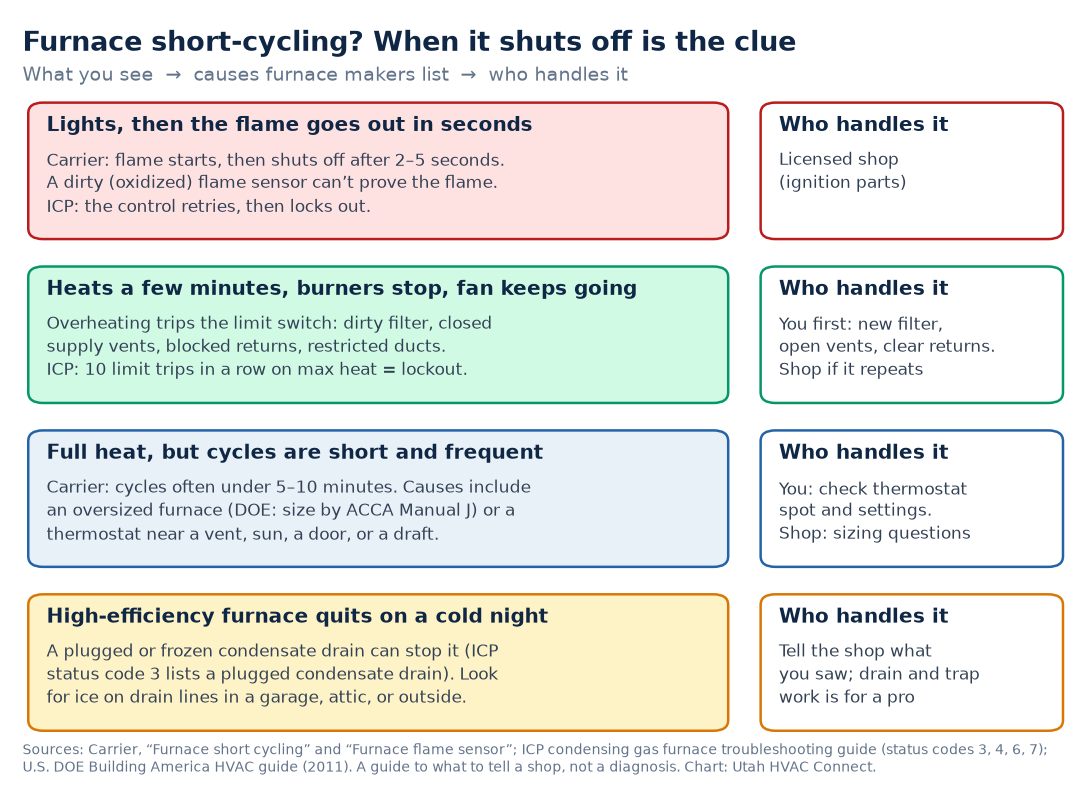
- The flame lights, then goes out within seconds. Carrier lists “furnace starts, then shuts off after 2–5 seconds” as a classic flame-sensor symptom: the furnace ignites, but the control board doesn’t get the flame signal it expects, so it closes the gas valve. Oxidation or carbon buildup on the sensor rod is the most common cause, and the number of retries before the furnace locks out varies by model (Carrier, flame sensor). On one ICP condensing furnace, for example, the control tries three more times before an ignition lockout (ICP guide, status code 6).
- It heats for a few minutes, then the burners stop while the fan keeps blowing. That often means the furnace overheated and the limit switch shut the burners off. Carrier’s short-cycling checklist starts with airflow: a dirty filter, closed supply registers, or blocked vents (Carrier). The ICP guide lists a dirty filter or restricted duct system under its limit-circuit code, and locks the furnace out after 10 limit trips in a row on maximum heat, with an automatic reset after 3 hours (ICP guide, status codes 4 and 7).
- It heats normally, but the cycles are short and frequent. Two common causes here are an oversized furnace, which heats the space quickly and shuts off before the whole house evens out, and a thermostat that reads the wrong temperature because it sits near a heat source or in a draft (Carrier).
- A high-efficiency furnace quits on the coldest nights. Condensing furnaces drain water. The ICP guide lists a plugged condensate drain under its pressure-switch code (ICP guide, status code 3), and a drain line that runs through a cold garage or outside can freeze. Our cold-air guide explains how that drain works.
Checks that are safe for you
These follow Carrier’s three-step short-cycling checklist (airflow, thermostat, then the furnace itself) (Carrier; Carrier troubleshooting):
- Airflow. Replace a dirty filter. Open every supply register and clear furniture or rugs off return grilles.
- Thermostat. Replace its batteries if it uses them, and look at where it hangs. Carrier recommends an interior wall away from direct sunlight, exterior doors, windows, air vents, drafts, and heat-producing appliances. A thermostat in a sunny spot or right over a vent can stop the furnace early.
- Look, don’t take apart. If your furnace has a status light, count the blink pattern through the viewing window and write it down. Check for ice on any white plastic drain line you can see. Leave the burners, flame sensor, and control board to a licensed technician.
- If it keeps cycling after those checks, Carrier’s advice is to turn the system off and contact a qualified HVAC professional; short-cycling adds wear on parts.
Why West Jordan’s home ages matter
West Jordan isn’t one housing era. By our calculation from the Census Bureau’s 2020 ZIP-to-place relationship file, about 93% of the city’s land area falls in three ZIPs, 84081, 84084, and 84088, and 84088 lies entirely inside the city (Census relationship file). Their homes were built in very different decades:
| ZIP | Housing units | Median year built | Built 1970s | Built 1980s | Built 1990s | Built 2000 or later | Heat with utility gas |
|---|---|---|---|---|---|---|---|
| 84084 (east / older West Jordan) | 10,610 | 1985 | 33% | 19% | 16% | 25% | 84% |
| 84088 (central / south) | 13,519 | 1993 | 15% | 19% | 38% | 23% | 85% |
| 84081 (west, toward the Oquirrhs) | 15,580 | 2004 | 2% | 14% | 16% | 66% | 86% |
Source: U.S. Census Bureau, ACS 2020–2024 5-year estimates for ZIP Code Tabulation Areas (tables B25034, B25035, B25040), via Census Reporter (84084, 84088, 84081). Year-built shares are of all housing units and don’t add to 100% because older decades are left out; heating fuel is for occupied homes. Estimates have margins of error.
What that suggests for a short-cycling furnace, as context rather than a diagnosis:
- 84084 and 84088 (median homes from 1985 and 1993): most of these homes are likely on at least their second furnace. DOE’s Building America guide says many older furnaces are oversized because contractors once sized by “rules of thumb,” and that a newer furnace “may be more efficient but is still likely to be oversized” (DOE Building America HVAC guide). If yours runs in short bursts and the house still feels uneven, sizing is a fair question to raise, especially if the furnace was replaced without a load calculation.
- 84081 (median home from 2004; 66% built 2000 or later): many furnaces here are original or close to it, and many are high-efficiency models that drain condensate. Before you approve a repair on a furnace that’s only a few years old, find your paperwork and ask whether the part is still under the manufacturer’s warranty. Our new-home furnace warranty guide covers how that works.
- Gas heat is the norm everywhere: 84% to 86% of occupied homes in all three ZIPs heat with utility gas, so the furnace patterns above apply to most houses.
If sizing comes up
DOE recommends sizing heating and cooling equipment with recognized load calculations, such as ACCA Manual J, instead of rules of thumb (Carrier, citing DOE). The Building America guide lists ACCA Manual J (heat loss and gain), Manual S (equipment selection), and Manual D (duct design), and notes that with the variable-speed motors in some newer furnaces, “oversizing is less of an issue” because the equipment can run at lower speeds when demand is low (DOE Building America HVAC guide). An oversized furnace usually isn’t a reason to replace a furnace that’s otherwise healthy. It matters most when you’re replacing anyway, and our furnace replacement guide covers that decision.
What to tell the shop
- How long a cycle lasts (time a few with your phone) and whether the flame goes out within seconds or after a few minutes.
- Whether the blower keeps running after the burners stop.
- Any blink code, and whether it started after a filter change, a thermostat swap, or a cold snap.
- The furnace’s age and whether it’s been replaced before, if you know.
- Ask what the technician found and measured, and get any repair-or-replace recommendation in writing.
If the furnace won’t run at all, start with no-heat help. Local housing, rebate, and permit details for the area are on our West Jordan and South Jordan page.
Permits in West Jordan
A repair usually doesn’t change the permit picture, but a replacement can. West Jordan’s Building & Safety Division issues permits and takes applications through the city’s online portal (West Jordan Building & Safety), and the city’s published monthly permit reports list furnace and air-conditioner permits (example report). If a shop recommends replacement, ask whether the permit is included.
Check the license before work starts
Before anyone works on your system, look the company up on DOPL’s free Licensee Lookup & Verification. You want an Active status and an HVAC classification (H100, or the older S350), under the same business name that’s on your estimate. Step-by-step: how to check a Utah HVAC license.
How matching works
- Tell us what you need on the free Get Help form: service type (Repair, Tune-up, or “I’m not sure”), urgency (Today, This week, or Planning), your ZIP, and when it’s reasonable to reach you.
- We match licensed Utah shops that serve your ZIP. We don’t dispatch technicians, diagnose, or write proposals.
- Matched pros may reach out using the contact details you provide. You talk with them, compare, and hire who you want, or no one. No homeowner fee and no obligation. More: how it works and how we make money.
Related guides
- Furnace not working? No-heat help in Utah: safety first, basic checks, and what to tell a shop
- Furnace and AC help in West Jordan & South Jordan: local housing data, rebates, and permit offices
- Why is my furnace blowing cold air? The causes furnace makers list, including the frozen-drain problem
- Inversion-season filters: why a too-tight filter can trip the high-limit switch
- Furnace replacement in Utah: repair-or-replace questions, sizing, rebates, permits
- Builder-grade furnace in a newer Utah home: check the warranty before you pay for a repair
- Upstairs hot, downstairs cold? Uneven floors in two-story homes
How we put this page together
This page was written by the Utah HVAC Connect editorial team, not by a contractor. We used public data only: NOAA 1991–2020 climate normals, U.S. Census Bureau American Community Survey (ACS) estimates, and the rebate, permit, and licensing pages published by Utah utilities, cities, and DOPL, each checked on the date shown above. For this article we pulled ZIP-level housing data for West Jordan’s three main ZIPs, checked how they line up with city limits using Census geography files, and read Carrier, ICP, and DOE guidance on short-cycling, flame sensors, limit switches, and sizing. We don’t publish prices we can’t source, contractors can’t pay to be mentioned here, and we don’t name partner shops on this page. Programs and rules change, so confirm details with the program or your contractor before you sign anything. See our editorial policy. Spot an error? Email hello@utahhvacconnect.com.
Sources
- Carrier, Understanding furnace short cycling
- Carrier, Furnace flame sensor
- Carrier, Troubleshooting a furnace
- ICP, condensing gas furnace troubleshooting guide (status codes 3, 4, 6, 7)
- U.S. DOE, Building America Best Practices Series Vol. 14, Energy Renovations: HVAC (PNNL/ORNL, 2011), “Bigger isn’t always better”
- U.S. Census Bureau, ACS 2020–2024 5-year, tables B25034, B25035, B25040, ZCTAs 84081, 84084, 84088, via Census Reporter API
- Census Reporter profile, ZCTA 84084
- Census Reporter profile, ZCTA 84088
- Census Reporter profile, ZCTA 84081
- U.S. Census Bureau, 2020 ZCTA-to-place relationship file
- West Jordan City, Building & Safety
- West Jordan City, building permit report
- Utah DOPL, Licensee Lookup & Verification
Questions about the service: hello@utahhvacconnect.com.
FAQ
What counts as short-cycling?
Carrier describes it as a furnace turning on and off repeatedly in cycles that are often less than 5 to 10 minutes, before it finishes a full heating cycle.
Why does my furnace light and then shut off after a few seconds?
Carrier lists that as a common flame-sensor symptom: the burners light, but the control board doesn’t detect the flame, so it shuts the gas off. Oxidation or carbon buildup on the sensor is the most common cause. It’s a job for a licensed technician.
Can a dirty filter make a furnace short-cycle?
Yes. A dirty filter or blocked vents can overheat the furnace and trip the limit switch, which shuts the burners off. Replacing the filter and opening supply registers is Carrier’s first check.
Can a furnace be too big for my West Jordan home?
It can. DOE’s Building America guide says many older systems were sized by rules of thumb and are oversized, and that even a newer replacement is still likely to be oversized. An oversized furnace heats quickly and shuts off early. A load calculation such as ACCA Manual J is how a shop checks size.
Where should my thermostat be?
Carrier recommends an interior wall away from direct sunlight, exterior doors, windows, air vents, drafts, and heat-producing appliances. A thermostat in the wrong spot can shut the furnace off before the rest of the house warms up.
Is the request free? Do you send a technician?
The request is free for homeowners, with no obligation to hire. We don’t send technicians or quote; we’re a matchmaker that connects you with licensed Utah HVAC shops that serve your ZIP, and matched pros may reach out.