TL;DR
- Under Utah Code 57-22-3 and 57-22-4, the owner must maintain heating in a rental, unless a signed written agreement explicitly shifts that duty.
- Tell the landlord in writing. For a dangerous condition, the owner must start fixing it within 24 hours of notice by any reasonable means.
- After a proper written notice of deficient condition, the owner has three calendar days for a habitability problem like heating. Remedies: rent abatement (you move out) or repair and deduct (up to two months’ rent). Both carry risk; get advice.
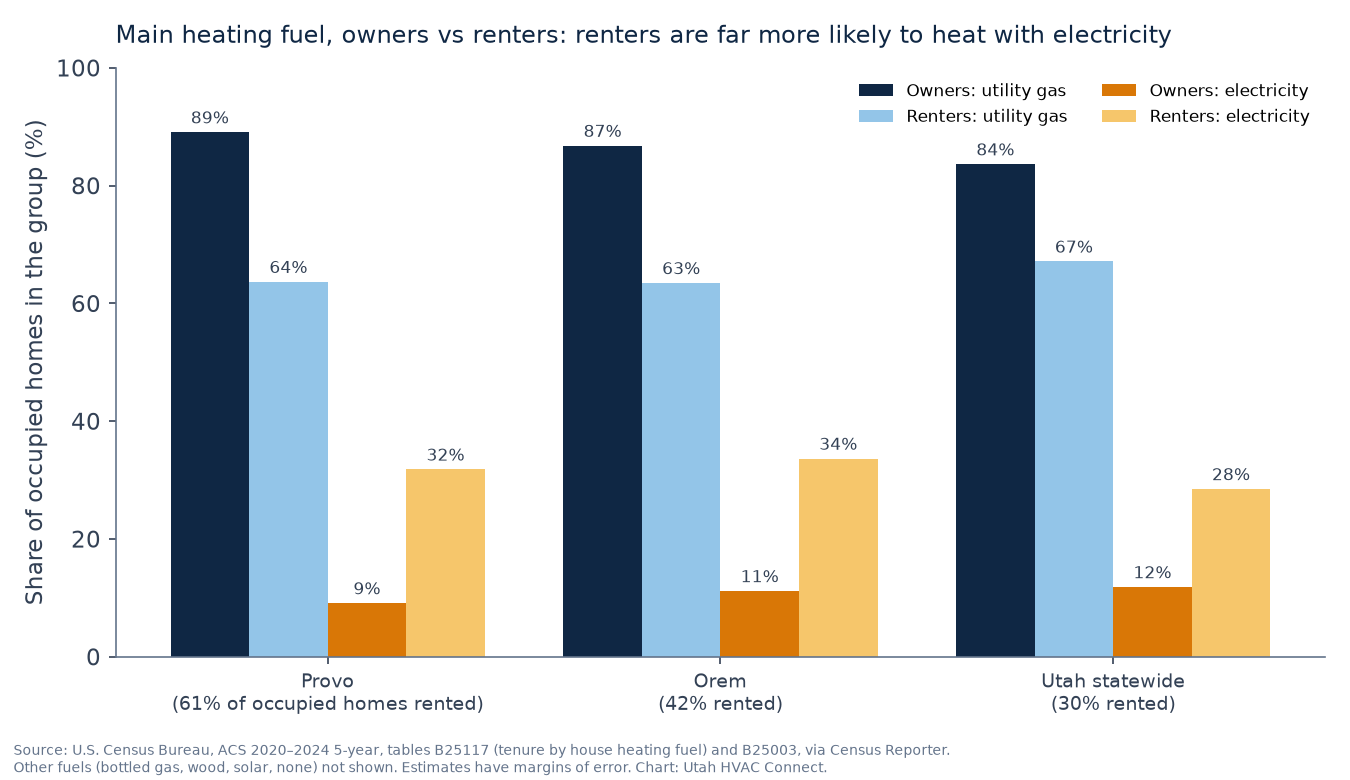
- About 61% of Provo’s occupied homes are rented, and 32% of renter households heat mainly with electricity (ACS 2020–2024).
- Provo licenses rental dwellings, requires working mechanical systems, and can inspect with reasonable cause at no fee.
If you rent in Provo and the heat goes out, the short answer under Utah law is that keeping the heating working is the owner’s job, with a few important exceptions, and there’s a specific process for when it isn’t fixed. This page walks through the Utah Fit Premises Act as written, the Provo rental rules that sit on top of it, and what to write down. More renters than owners live in Provo, so this question comes up a lot.
This is general information, not legal advice. Utah Legal Services and the Utah State Courts’ Self-Help Center (linked below) can help with your situation. Utah HVAC Connect is a matchmaker that connects people who can approve HVAC work with licensed Utah contractors. We’re not a contractor or a law firm, and we don’t dispatch, diagnose, or quote.
Safety first: if you smell gas or a carbon monoxide alarm sounds, leave the home, then call 911 or Enbridge Gas at 1-800-767-1689 from outside (Enbridge Gas). Then tell your landlord.
Provo renters, by the numbers
About 61% of Provo’s occupied homes are rented (20,630 of 34,022), compared with 42% in Orem and 30% statewide. Renters also heat differently: about 32% of Provo renter households heat mainly with electricity, vs about 9% of Provo owners (ACS 2020–2024, tables B25003 and B25117). The law below talks about “heating,” not a fuel, so it covers an electric system as much as a gas furnace.
Who is responsible for the heat
- The owner. Utah Code 57-22-3 says each owner and owner’s agent must keep a rental “fit for human habitation,” in line with local ordinances and health rules, and that each rental “shall have electrical systems, heating, plumbing, and hot and cold water” (57-22-3). Section 57-22-4 adds that the owner shall “maintain electrical systems, plumbing, heating, and hot and cold water” and maintain any air conditioning system “in an operable condition” (57-22-4).
- Exception: the lease can shift a duty. “Any duty in this act may be allocated to a different party by explicit written agreement signed by the parties” (57-22-3(4)). Read your lease for anything that makes you responsible for HVAC work.
- Exception: minor problems. The chapter doesn’t apply to “breakage, malfunctions, or other conditions which do not materially affect the physical health or safety of the ordinary renter” (57-22-3(3)).
- Your side. Renters must use heating and other facilities “in a reasonable manner,” be current on all payments the lease requires, follow the lease, and not unreasonably deny the owner access to make repairs (57-22-5). A problem the renter, family, or guests caused isn’t a “deficient condition” under the remedies section (57-22-6(1)).
What to do, step by step
- Check the simple things your lease allows. Thermostat set to Heat and a few degrees above room temperature, fan on Auto, breaker not tripped, and, if the lease lets you, a clean filter. Our no-heat basic checks list what’s safe. Don’t open the furnace or touch the gas valve.
- Tell the landlord or property manager right away, in writing. Utah Legal Services says it’s best to give notice of needed repairs in writing, because talking may not be enough to protect your rights, and your lease may say how to report repairs (Utah Legal Services). Note the date and time, what’s happening (no heat at all, cold air, short cycling), and the indoor temperature if you have a thermometer.
- If it’s dangerous, say so. For a dangerous condition, the law lets you notify the owner by any reasonable means, and the owner must start fixing it within 24 hours. Utah Legal Services lists “no working furnace” among serious problems (57-22-6(3); Utah Legal Services).
- If it isn’t fixed, consider the formal notice. The written notice of deficient condition, the corrective period, and the two remedies are summarized in the table below. Utah Legal Services and the courts’ Self-Help Center have the notice form and explain how to serve it (Utah State Courts, Housing self-help).
| Step | What Utah Code 57-22-6 says | Time |
|---|---|---|
| Dangerous condition: tell the owner | For a condition posing a substantial risk of imminent loss of life or significant physical harm, the renter may notify the owner “by any means that is reasonable under the circumstances.” The owner must start remedial action and diligently pursue it to completion. | Owner starts within 24 hours of notice |
| Written notice of deficient condition | Describes each condition, states the corrective period, names the remedy the renter chose, gives permission to enter to fix it, and is served as the law or the rental agreement provides. A phone call about a dangerous condition doesn’t count as this notice unless it also meets these rules. | Corrective period: 3 calendar days for a standard of habitability (heating is one); 10 for a requirement that only comes from the lease |
| Remedy if the owner doesn’t take substantial action in time: rent abatement | The rental agreement ends, rent is abated from the date of the notice, and the owner must pay back the security deposit and prorated prepaid rent. The renter must move out. | Renter vacates within 10 calendar days after the corrective period ends |
| Or: repair and deduct | The renter may correct the condition and deduct the cost from future rent, up to two months’ rent, keeping receipts and giving the owner copies. | Receipts within 5 calendar days after the next rental period begins |
| Owner’s alternative | If the unit isn’t fit for occupancy, the owner may decide not to fix it and end the rental agreement, in writing by the end of the corrective period, refunding prepaid rent and any deposit due. | Refund within 10 calendar days; renter can’t be required to leave sooner than 10 days after the notice |
Summarized from Utah Code 57-22-6 (effective July 1, 2024, as shown on le.utah.gov on November 16, 2026). Remedies are only available to a renter who is in compliance with Utah Code 57-22-5, which includes being current on all payments. This is a summary, not legal advice.
Read the cautions before choosing a remedy. Utah Legal Services warns that if you deduct repairs from rent, the landlord may say the repairs were unnecessary and file an eviction case, which is risky even if you win, and that rent abatement means moving out, so “only use this option if moving out is something you can do.” It also notes you still owe rent while you live there (Utah Legal Services). Courts can award costs and reasonable attorney fees to the prevailing party in an action under this chapter (57-22-6(7)). Get advice before you rely on either remedy.
Provo’s rental rules
- Rental dwelling license. Provo City Code Chapter 6.26 covers rental dwellings, including a license requirement (6.26.020) and minimum health and safety requirements (6.26.100) (Provo City Code 6.26).
- Mechanical systems. Each rental dwelling must meet the building code requirements needed for “proper installation, maintenance and operational condition of all plumbing, electrical, and mechanical systems,” along with items like smoke alarms and egress windows (Provo City Code 6.26.100).
- Inspections. A licensed rental can be inspected when there’s reasonable cause to believe it violates an applicable law or ordinance, and the city charges no fee to inspect a rental dwelling (Provo City Code 6.01.070). Utah Legal Services notes that calling the building inspector or health department can prompt repairs, and that evicting a tenant for calling an inspector is illegal retaliation in Utah, though hard to prove, so write down when you called (Utah Legal Services). Provo City’s main line is (801) 852-6000.
For landlords and property managers
The same statute gives you the corrective periods above, so speed matters: 24 hours to start on a dangerous condition and three calendar days after a proper written notice for a habitability problem. If you manage several Provo units, it helps to know before winter which ones heat with gas and which with electricity, and to have a licensed contractor lined up. Ask any shop for an Active DOPL license, and ask whether the furnace in an older unit is due for a repair-or-replace conversation: see our furnace replacement guide and Provo and Orem local data. If the unit gets a heat pump, Provo Power has its own rebate: Provo heat pump rebate.
Bringing in a licensed shop
Our request form is for the person who can approve the work: usually the landlord, owner, or property manager. If you’re a renter, talk to your landlord first; if you’re acting under a repair-and-deduct notice, get advice before you hire anyone, and use a licensed contractor. Inversion season is also when furnaces work hardest and filters matter most: inversion-season filters and airflow.
Check the license before work starts
Before anyone works on your system, look the company up on DOPL’s free Licensee Lookup & Verification. You want an Active status and an HVAC classification (H100, or the older S350), under the same business name that’s on your estimate. Step-by-step: how to check a Utah HVAC license.
How matching works
- Tell us what you need on the free Get Help form: service type (Repair, or “I’m not sure”), urgency (Today, This week, or Planning), your ZIP, and when it’s reasonable to reach you.
- We match licensed Utah shops that serve your ZIP. We don’t dispatch technicians, diagnose, or write proposals.
- Matched pros may reach out using the contact details you provide. You talk with them, compare, and hire who you want, or no one. No homeowner fee and no obligation. More: how it works and how we make money.
Related guides
- Furnace not working? No-heat help in Utah: safety first, basic checks
- Provo & Orem: housing data, Provo Power vs Rocky Mountain Power, and permits
- Inversion season: furnace filters and airflow
- Furnace blowing cold air: safe checks and the common causes
- Provo heat pump rebate: who qualifies and how to apply
How we put this page together
This page was written by the Utah HVAC Connect editorial team, not by a contractor. We used public data only: NOAA 1991–2020 climate normals, U.S. Census Bureau American Community Survey (ACS) estimates, and the rebate, permit, and licensing pages published by Utah utilities, cities, and DOPL, each checked on the date shown above. For this article we read the Utah Fit Premises Act sections on le.utah.gov, Utah Legal Services’ bad-housing guide, the courts’ housing self-help page, and Provo’s rental dwelling code, and pulled ACS data on tenure and heating fuel. We are not lawyers; we quote the statute and link it so you can read it yourself. We don’t publish prices we can’t source, contractors can’t pay to be mentioned here, and we don’t name partner shops on this page. Programs and rules change, so confirm details with the program or your contractor before you sign anything. See our editorial policy. Spot an error? Email hello@utahhvacconnect.com.
Sources
- Utah Code 57-22-3, Duties of owners and renters, generally
- Utah Code 57-22-4, Owner’s duties
- Utah Code 57-22-5, Renter’s duties
- Utah Code 57-22-6, Renter remedies for deficient condition of residential rental unit
- Utah Legal Services, Bad Housing (last updated March 6, 2024)
- Utah State Courts, Self-Help Resources: Housing
- Provo City Code, Chapter 6.26 Rental Dwellings
- Provo City Code 6.26.100, Minimum Health and Safety Requirements
- Provo City Code 6.01.070, Inspections
- U.S. Census Bureau, ACS 2020–2024 5-year, tables B25003 and B25117, Provo and Orem cities and Utah, via Census Reporter API
- Enbridge Gas (Utah, Idaho & Wyoming)
- Utah DOPL, Licensee Lookup & Verification
Questions about the service: hello@utahhvacconnect.com.
FAQ
Does my landlord have to fix the furnace in Utah?
Generally yes. Utah Code 57-22-3 and 57-22-4 require owners to maintain heating in a rental. A lease can shift a duty only by explicit written agreement signed by the parties, and the law doesn’t cover minor problems that don’t materially affect health or safety. This is general information, not legal advice.
How long does a Utah landlord have to fix the heat?
Under Utah Code 57-22-6, after a proper written notice of deficient condition, the corrective period for a standard of habitability such as heating is three calendar days. For a dangerous condition, the owner must start remedial action within 24 hours of being notified by any reasonable means.
Can I withhold rent if the heat is out?
The law doesn’t provide simple rent withholding. It provides two remedies after a proper notice: rent abatement, which ends the lease and requires you to move out, or repair and deduct, capped at two months’ rent. Both require being current on payments. Utah Legal Services warns that a deduction can lead to an eviction case, so get advice first.
Can I hire my own HVAC contractor and deduct it?
Only through the repair-and-deduct remedy after a proper written notice and the corrective period passing without substantial action by the owner, and only up to two months’ rent, with receipts given to the owner. Get advice before relying on it.
Does Provo inspect rentals?
Provo requires a rental dwelling license and minimum health and safety standards, including working mechanical systems. A licensed rental can be inspected when there’s reasonable cause to believe it violates a law or ordinance, and Provo charges no fee for a rental dwelling inspection.
My apartment has electric heat. Does the law still apply?
Yes. The statute says “heating,” not a fuel. About 32% of Provo renter households heat mainly with electricity (ACS 2020–2024).
Can a renter use your request form?
Our form is for the person who can approve the work, usually the landlord, owner, or property manager. We’re a matchmaker that connects them with licensed Utah HVAC shops; we don’t dispatch or quote, and the request is free with no obligation.