TL;DR
- Sandy’s “A/C Furnace replacement” permit covers the replacement or addition of any HVAC system, including a gas line upgrade.
- Apply, pay, schedule, and track it in the Sandy Cityworks portal. Ask whether your licensed contractor applies for it.
- City fees (FY 2027): $105 for a residential AC/Furnace permit plus a 1% state fee; $70 for a re-inspection.
- Utah law: if the city can’t inspect within three business days, the applicant may use a third-party firm from the city’s list. Violations must be given in writing the same day.
- Ask whether the job needs carbon monoxide alarms, who pays a re-inspection, and who files the rebates.
Sandy requires a permit to replace a furnace or central AC. Our Draper and Sandy page says that much, and our east Sandy furnace guide walks through the city’s permit sheet. This page goes one step further: what happens between the application and a closed permit, the fees Sandy publishes, how inspections work under Utah law, the carbon monoxide alarm question, and what to ask your contractor before work starts.
Utah HVAC Connect is a matchmaker. We connect homeowners with licensed Utah HVAC contractors; we’re not a contractor, we don’t pull permits, and we don’t quote. This is a plain-English summary of public pages, not legal advice. Sandy’s Building & Code Compliance Division has the final word.
What the permit covers
Sandy’s residential mechanical permit sheet lists three mechanical permits. The one for this job is “A/C Furnace replacement”: “the replacement or addition of any HVAC system,” which includes a gas line upgrade. Separate permits cover gas line work that isn’t part of another permit and other mechanical alterations or repairs (Sandy residential mechanical permits).
The city’s general rule is broad. Its building permits page says a permit is required to “erect, install, enlarge, alter, repair, remove, convert or replace any electrical, gas, mechanical or plumbing system” regulated by the code. The same page lists the codes Sandy applies, including the 2021 International Residential Code, the 2024 International Mechanical Code, the 2024 International Fuel Gas Code, and the 2024 International Energy Conservation Code (Sandy building permits).
Step by step: application to a closed permit
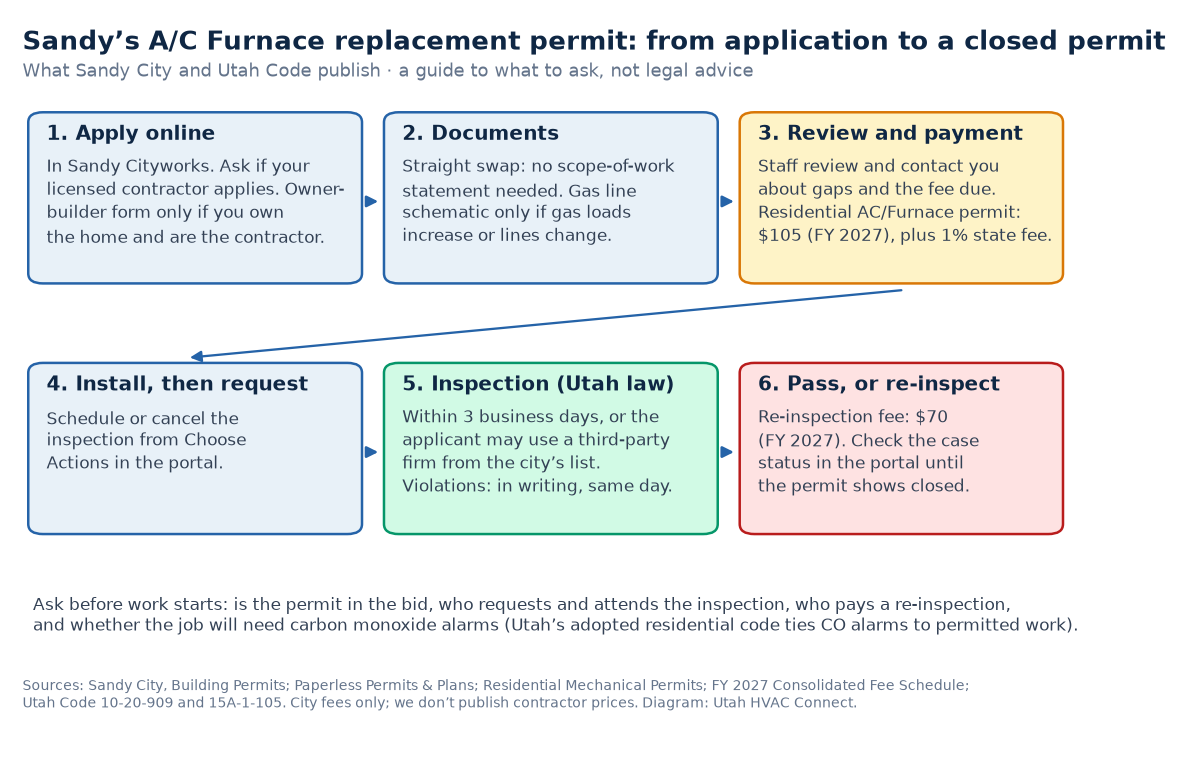
- Who applies. Ask whether your licensed contractor will apply for the permit and whether it’s in the bid. Sandy’s sheet asks for an Owner Builder Form only “if you own the home and are acting as contractor” (Sandy).
- Documents. For a straight replacement, Sandy says a scope-of-work statement is “not necessary if just replacing appliances,” and a gas line schematic is needed only if gas loads increase or lines change (Sandy).
- Apply online. Applications go through the Sandy Cityworks portal. You sign up with an email address and confirm it with an activation link (Sandy Paperless Permits & Plans).
- Review and payment. Sandy says that once an application is received, staff review it and contact the applicant about any deficiencies and the payment due. Fees are paid in the portal (Sandy building permits; Sandy).
- Install, then request the inspection. In the portal, the “Choose Actions” menu is where you pay fees, schedule or cancel an inspection, and check case status (Sandy).
- The inspection. Utah law sets the clock. If a city collects a fee for inspection and can’t inspect within three business days after the request, the permit applicant may hire a third-party inspection firm from the city’s approved list. If you ask for a date more than three days out, the city inspects on the date you asked for (Utah Code 10-20-909(2)). Before using a third-party firm, the applicant has to tell the city which firm it intends to use (Utah Code 15A-1-105).
- If something fails. The inspector has to give the permit holder written notice that identifies each violation, delivered the same day, with a reference to the code provision on request (Utah Code 10-20-909(2)(d)). After the fix, a re-inspection fee can apply (see the fees below).
- Close it out. Check the case status in the portal until the permit shows the inspection passed.
How many inspection visits a straight furnace or AC replacement needs isn’t stated on the Sandy pages we read. Ask your contractor, or call Sandy’s permit line at (801) 568-7279 (Sandy). Community Development is at 10000 S Centennial Parkway, Suite 210, 801-568-7250, Monday to Friday, 8 a.m. to 5 p.m. (Sandy).
The fees Sandy publishes
| Line in Sandy’s fee schedule | Amount (2027 column) | What it means for you |
|---|---|---|
| Residential permits: AC/Furnace | $105 | The city permit fee for the replacement permit itself |
| State regulated 1% toward all building fees | 1% of total permit fee | A state surcharge added to building permit fees |
| Re-inspection fee | $70 | Applies when an inspection has to be repeated |
| Work without a permit investigation fee | Equal to the permit fee | Why skipping the permit doesn’t save the fee |
| Plan review fee | 65% of total permit fee | Listed for building permits generally; ask whether it applies to a straight replacement |
Source: Sandy City Consolidated Fee Schedule (FY 2027), Building & Safety section, linked from Sandy’s Billing & Fees page. These are city fees, not what a contractor charges. We don’t publish contractor prices.
Two practical points. A re-inspection costs money, so it’s worth asking who pays if the first inspection fails. And unpermitted work can bring an investigation fee equal to the permit fee, so a bid that “saves” you the permit isn’t saving the fee.
Carbon monoxide alarms: ask before the job
Utah adopts the International Residential Code with state amendments, which are listed in Utah Code 15A-3-202. Utah’s current amendments keep IRC section R315.2.2, the rule on carbon monoxide alarms when permitted alterations or repairs happen (Utah adds accessory dwelling units to it), and add “on each level of the dwelling unit” to the CO alarm location rule in R315.3 (Utah Code 15A-3-202).
The Rocky Mountain Gas Association’s code column quotes the 2021 IRC text: where alterations, repairs, or additions requiring a permit occur, the dwelling unit “shall be equipped with carbon monoxide alarms located as required for new dwellings.” Its point for contractors is that the 2021 edition narrowed the mechanical exception to systems that are not fuel fired (RMGA code column). In plain terms, a permitted gas furnace replacement can bring a CO alarm requirement. Ask your contractor whether the bid includes alarms, and ask Sandy’s building division if you’re not sure. CO is colorless and odorless, which is why working alarms matter with any gas appliance (EPA).
Keep the paperwork for rebates
- ThermWise (Enbridge Gas): a rebate request must be postmarked within six months of the installation date (ThermWise).
- Wattsmart (Rocky Mountain Power): the dual-fuel rebate requires an existing single-family home, electricity from Rocky Mountain Power, and work by a program-participating contractor (Wattsmart). Check the name on your electric bill, and ask whether the bidder participates.
- Ask for an itemized invoice with the model numbers, and keep the permit number with it.
What the rebates are and how they compare is in our furnace replacement guide.
What to ask your contractor
- Is the Sandy A/C Furnace replacement permit included in the bid, and will you pull it under your license?
- Does the job change the gas line or gas load? If so, a gas line schematic is needed, and a separate gas line permit may come into play.
- Who requests the inspection, and does someone need to be home for it?
- If the inspection fails, who pays the re-inspection fee?
- Will the job need carbon monoxide alarms, and are they in the bid?
- Will you send me the permit number and the final inspection result?
- Which rebates does this equipment qualify for, and who files them?
Still deciding whether to replace at all? See repair or replace, and for older east-side homes, replacing the furnace in a 1970s–80s east Sandy home.
Check the license before work starts
Before anyone works on your system, look the company up on DOPL’s free Licensee Lookup & Verification. You want an Active status and an HVAC classification (H100, or the older S350), under the same business name that’s on your estimate. Step-by-step: how to check a Utah HVAC license.
How matching works
- Tell us what you need on the free Get Help form: service type (Replace, or “I’m not sure”), urgency (Today, This week, or Planning), your ZIP, and when it’s reasonable to reach you.
- We match licensed Utah shops that serve your ZIP. We don’t dispatch technicians, diagnose, or write proposals.
- Matched pros may reach out using the contact details you provide. You talk with them, compare, and hire who you want, or no one. No homeowner fee and no obligation. More: how it works and how we make money.
Related guides
- Furnace and AC help in Draper & Sandy: housing data, utilities, and permits
- Furnace replacement in Utah: repair or replace, rebates, and what drives a bid
- Replacing the furnace in a 1970s–80s east Sandy home: venting, ducts, and the permit sheet
- AC and heat pump replacement in Utah: AC-only, dual fuel, or all-electric
- What drives furnace replacement cost in American Fork and Pleasant Grove: how two other cities set permit fees
How we put this page together
This page was written by the Utah HVAC Connect editorial team, not by a contractor. We used public data only: NOAA 1991–2020 climate normals, U.S. Census Bureau American Community Survey (ACS) estimates, and the rebate, permit, and licensing pages published by Utah utilities, cities, and DOPL, each checked on the date shown above. For this article we read Sandy’s building permit, paperless permit, and mechanical permit pages, the city’s FY 2027 fee schedule, the Utah Code sections on inspection timing, third-party inspectors, and the state’s residential code amendments, and a Utah gas trade association’s code column on CO alarms. We don’t publish prices we can’t source, contractors can’t pay to be mentioned here, and we don’t name partner shops on this page. Programs and rules change, so confirm details with the program or your contractor before you sign anything. See our editorial policy. Spot an error? Email hello@utahhvacconnect.com.
Sources
- Sandy City, Building Permits
- Sandy City, Paperless Permits & Plans
- Sandy City, Residential Mechanical Permits (PDF)
- Sandy City, Consolidated Fee Schedule, FY 2027 (PDF)
- Sandy City, Billing & Fees
- Utah Code 10-20-909, Fees collected for construction approval (effective Nov 6, 2025)
- Utah Code 15A-1-105, Third-party inspection firms (effective Jan 1, 2026)
- Utah Code 15A-3-202, Amendments to Chapters 1 through 5 of IRC (effective July 1, 2026)
- Rocky Mountain Gas Association, 2021 I-Code adoption: furnace and water heater replacements and CO detectors (PDF)
- U.S. EPA, What is carbon monoxide?
- Enbridge Gas, ThermWise appliance rebates
- Rocky Mountain Power, Wattsmart dual fuel heat pumps (UT)
- Utah DOPL, Licensee Lookup & Verification
Questions about the service: hello@utahhvacconnect.com.
FAQ
Do I need a permit to replace a furnace or AC in Sandy?
Yes. Sandy City lists an “A/C Furnace replacement” permit for the replacement or addition of any HVAC system, including a gas line upgrade. Applications go through the Sandy Cityworks portal; ask whether your licensed contractor applies for it.
How much is Sandy’s furnace or AC permit?
Sandy’s FY 2027 consolidated fee schedule lists $105 for a residential AC/Furnace permit, plus a 1% state fee on building permit fees. A re-inspection is $70. Those are city fees only; contractor pricing is separate, and we don’t publish it.
How do I schedule a Sandy HVAC inspection?
In the Sandy Cityworks portal, use the Choose Actions menu on the permit to schedule or cancel an inspection and to check the case status. Your contractor usually does this. Permit questions: (801) 568-7279.
How fast does Sandy have to inspect?
Under Utah Code 10-20-909, if a city can’t inspect within three business days after the request, the permit applicant may hire a third-party inspection firm from the city’s approved list, after telling the city which firm. If you ask for a later date, the city inspects on that date.
Will I need carbon monoxide alarms when I replace my gas furnace?
Possibly. Utah’s adopted residential code ties CO alarms to permitted alterations and repairs, and the 2021 edition narrowed the exception to mechanical systems that aren’t fuel fired. Ask your contractor and, if unsure, Sandy’s building division.
Can I pull the permit myself?
Sandy’s permit sheet has an Owner Builder Form for someone who owns the home and is acting as the contractor. If you hire a licensed contractor, ask whether they pull the permit. Check any contractor’s license on DOPL’s free lookup.
Do you pull permits or do the installation?
No. We’re a matchmaker: we connect homeowners with licensed Utah HVAC shops that serve their ZIP. We don’t install, pull permits, or quote. The request is free, with no obligation to hire.