TL;DR
- No prices here. The only dollar figures are official city fees.
- American Fork is split at both ends: about a third of homes built before 1980 and a third in 2010 or later. Pleasant Grove is spread more evenly (ACS 2020–2024).
- The home’s era often decides the scope: venting and liners in older homes, R-22 and matched coils in 2000s homes, warranty checks in newer ones.
- American Fork bases permit fees on job valuation and lists a $175 reinspection fee and a $125 inspection cancellation fee (July 2026 schedule).
- Pleasant Grove collects a submittal fee that’s credited toward the permit. Compare bids on the same itemized scope.
We don’t publish furnace prices, and this page won’t either. What we can do is show what tends to move a furnace replacement bid in American Fork and Pleasant Grove, using local housing data and the fees the two cities publish, so you can compare bids line by line. The only dollar amounts below are official city fees.
Utah HVAC Connect is a matchmaker. We connect homeowners with licensed Utah HVAC contractors; we’re not a contractor, and we don’t quote. The general list of bid drivers (efficiency, sizing, staging, ductwork, haul-away) is in our furnace replacement guide; this page adds what’s specific to these two cities.
Two cities, two housing mixes
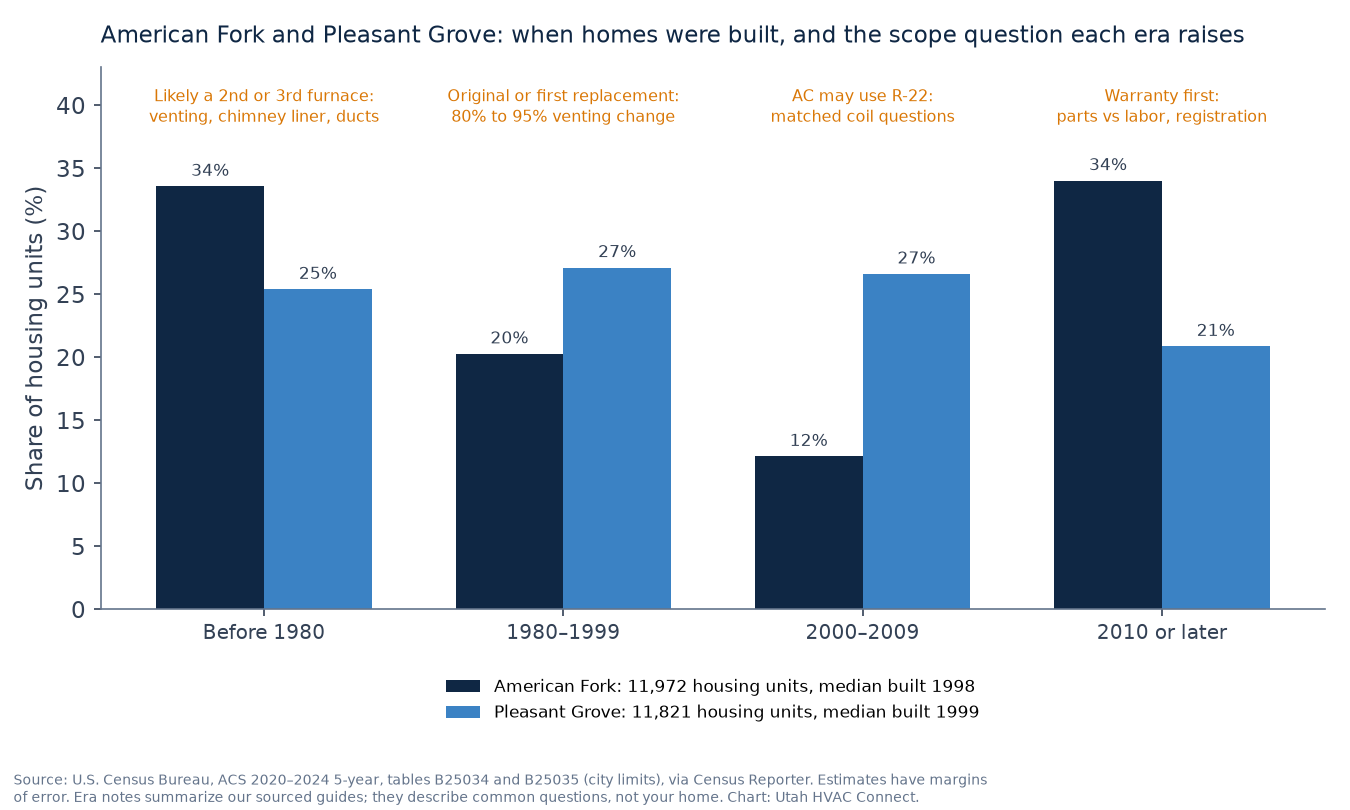
The two cities have nearly the same number of homes and almost the same median build year, but very different mixes. American Fork is split at both ends: about a third of its housing units were built before 1980 and another third in 2010 or later, with only 12% from the 2000s. Pleasant Grove is spread more evenly, with about a quarter in each era and its biggest share from 1980 through 2009 (ACS 2020–2024). That matters because the era of the home often decides which scope questions show up in a bid:
- Before 1980: the furnace has likely been replaced at least once. Venting, an old chimney, and older ductwork are the usual questions. See replacing the furnace in a 1970s–80s home.
- 1980 through 1999: often an original furnace or a first replacement. Moving from a non-condensing furnace to a 90%-plus model means PVC venting, a condensate drain, and possibly a water heater chimney liner. See what changes in a 1990s–2001 home.
- 2000 through 2009: an original AC may use R-22, and a new AC usually means a matched indoor coil. See early-2000s cost factors.
- 2010 or later: check the warranty before paying for parts. See builder-grade furnace warranties.
| City limits (ACS 2020–2024) | American Fork | Pleasant Grove |
|---|---|---|
| Housing units | 11,972 | 11,821 |
| Median year built | 1998 | 1999 |
| Built before 1980 | 34% | 25% |
| Built 1980–1999 | 20% | 27% |
| Built 2000–2009 | 12% | 27% |
| Built 2010 or later | 34% | 21% |
| Single-family attached (townhome-style) | 12% | 11% |
| Buildings with 5 or more units | 18% | 20% |
| Occupied homes heating with utility gas | 82% | 85% |
| Heating with electricity | 16% | 12% |
Source: U.S. Census Bureau, ACS 2020–2024 5-year estimates, tables B25034, B25035, B25024, B25040, via Census Reporter. Year built and home type are shares of all housing units; heating fuel is a share of occupied homes. Our American Fork page uses ZIP 84003, which is larger than the city, so its numbers differ. Estimates have margins of error.
Home type and where the equipment sits
About 12% of American Fork’s housing units and 11% of Pleasant Grove’s are single-family attached homes, and about a fifth in each city are in buildings with five or more units (ACS table B25024). In attached homes and condos, where the furnace sits (a closet, an attic, a garage) and where the outdoor unit can go shape the labor and any HOA approval. Ask about access and any HOA rules before you compare bids.
Heating fuel matters too. About 82% of occupied homes in American Fork and 85% in Pleasant Grove heat with utility gas; 16% and 12% heat with electricity (ACS table B25040). If your home heats with electricity now, the comparison is different. Start with AC and heat pump replacement.
City permit fees: how each city charges
American Fork bases building permit fees on the valuation of the work, using a city table (American Fork, Building Permit Fees; valuation table). That means the permit fee grows with the declared value of the job. The city also lists:
- a plan review fee based on valuation, with a $50 minimum for permits other than new homes;
- a state fee of 1% of the building permit fee;
- a 3% credit card processing fee on permit payments over $300 (American Fork);
- in its fee schedule effective July 1, 2026: a residential reinspection fee of $175 per unit, an inspection cancellation fee of $125 per unit for any scheduled inspection, and a $50 gas line review (American Fork FY 2026–2027 fee schedule).
The reinspection and cancellation fees are the ones a homeowner can feel: a failed or missed inspection costs real money in American Fork. Ask who pays them if it happens.
Pleasant Grove works differently. After an application is submitted, a permit technician reviews it and calls to collect a submittal (plan check) fee, which is applied toward the total cost of the building permit. Applications need a contractor’s license number or an Owner-Builder Certification Form (Pleasant Grove Building Division). The city’s fee schedule page lists a $75 submittal fee for “All Others (Solar, Signs, Basements)” (Pleasant Grove fee schedule). It doesn’t name HVAC work, so ask the city or your contractor which category a furnace permit falls under. Cedar Hills shares ZIP 84062 but issues its own permits (see our Pleasant Grove page).
Rules that change the scope
- Federal minimums. New non-weatherized gas furnaces have had to reach 80% AFUE since November 19, 2015, and, as codified today, must reach 95% for units made on and after December 18, 2028 (10 CFR 430.32(e)). A home with a metal flue that moves to a condensing furnace has venting work in the bid. More in our guide to the 2028 rule.
- Rebates can change the net, not the bid. Enbridge Gas ThermWise lists furnace rebates for 95% AFUE and higher, and the request must be postmarked within six months of installation (ThermWise). Rocky Mountain Power’s Wattsmart dual-fuel rebate requires Rocky Mountain Power electricity and a program-participating contractor (Wattsmart). Rocky Mountain Power’s service map lists both cities (RMP service area map), but check the name on your bill. Current amounts are on each program’s page.
How to compare bids in American Fork or Pleasant Grove
- Same scope on every bid, with model numbers and the AHRI reference number for any matched furnace, coil, and AC.
- Permit included? Which city issues it (American Fork, Pleasant Grove, or Cedar Hills), and is the city fee in the bid?
- Inspections. Who schedules and attends them, and who pays an American Fork reinspection or cancellation fee if one happens?
- Venting, liner, and drain for an older home; coil for an R-22-era AC; warranty for a newer home.
- Access and HOA for attached homes and condos.
- Haul-away and rebate paperwork: listed, and who files.
- License: check every bidder on DOPL (below).
Weighing whether to replace at all? See repair or replace an original furnace. Heat out right now? Start with no-heat help.
Check the license before work starts
Before anyone works on your system, look the company up on DOPL’s free Licensee Lookup & Verification. You want an Active status and an HVAC classification (H100, or the older S350), under the same business name that’s on your estimate. Step-by-step: how to check a Utah HVAC license.
How matching works
- Tell us what you need on the free Get Help form: service type (Replace, or “I’m not sure”), urgency (Today, This week, or Planning), your ZIP, and when it’s reasonable to reach you.
- We match licensed Utah shops that serve your ZIP. We don’t dispatch technicians, diagnose, or write proposals.
- Matched pros may reach out using the contact details you provide. You talk with them, compare, and hire who you want, or no one. No homeowner fee and no obligation. More: how it works and how we make money.
Related guides
- Furnace and AC help in American Fork (84003): housing data, utilities, and permits
- Furnace and AC help in Pleasant Grove: local data, rebates, and the permit rule
- Furnace replacement in Utah: repair or replace, rebates, and what drives a bid
- Original furnace in a 1990s–2001 American Fork home: repair or replace?
- What drives HVAC costs in Riverton and Herriman homes (no prices)
- Sandy’s furnace and AC replacement permit: steps, fees, and inspection
How we put this page together
This page was written by the Utah HVAC Connect editorial team, not by a contractor. We used public data only: NOAA 1991–2020 climate normals, U.S. Census Bureau American Community Survey (ACS) estimates, and the rebate, permit, and licensing pages published by Utah utilities, cities, and DOPL, each checked on the date shown above. For this article we pulled city-level housing, home-type, and heating-fuel data for American Fork and Pleasant Grove, and read both cities’ permit fee pages and American Fork’s adopted fee schedule. Scope notes by era summarize our earlier sourced guides, which are linked. We don’t publish prices we can’t source, contractors can’t pay to be mentioned here, and we don’t name partner shops on this page. Programs and rules change, so confirm details with the program or your contractor before you sign anything. See our editorial policy. Spot an error? Email hello@utahhvacconnect.com.
Sources
- U.S. Census Bureau, ACS 2020–2024 5-year, tables B25034, B25035, B25003, B25040, B25024, B25018, American Fork and Pleasant Grove cities, via Census Reporter API
- American Fork City, Building Permit Fees
- American Fork City, Building Permit Fees and Valuation Table (PDF)
- American Fork City, Adopted Fee Schedule, effective July 1, 2026 (PDF)
- Pleasant Grove City, Building Division
- Pleasant Grove City, Fee Schedule
- eCFR, 10 CFR 430.32 (furnaces, paragraph (e))
- Enbridge Gas, ThermWise appliance rebates
- Rocky Mountain Power, Wattsmart dual fuel heat pumps (UT)
- Rocky Mountain Power, service area map (PDF)
- Utah DOPL, Licensee Lookup & Verification
Questions about the service: hello@utahhvacconnect.com.
FAQ
How much does a furnace replacement cost in American Fork?
We don’t publish prices; your real number comes from licensed contractors who see the home. What moves a bid: the home’s era (venting, coil, warranty), access and HOA rules, efficiency and sizing, and city permit fees. Get at least two itemized bids for the same scope.
How does American Fork calculate a permit fee?
American Fork bases building permit fees on the valuation of the work using a city table, adds a plan review fee with a $50 minimum for most permits, and a state fee of 1% of the permit fee. Its July 1, 2026 fee schedule lists a $175 residential reinspection fee and a $125 inspection cancellation fee.
What does Pleasant Grove charge to apply for a permit?
Pleasant Grove collects a submittal (plan check) fee after a permit technician reviews the application, and applies it toward the building permit. Its fee schedule page lists $75 for “All Others (Solar, Signs, Basements)”; ask whether a furnace permit falls in that category.
Why would two bids for the same furnace be so different?
Often because the scope differs: one includes new PVC venting, a chimney liner, a matched coil, the permit, or haul-away and the other doesn’t. Ask every bidder to list the same items with model numbers so you can compare.
Do rebates lower the price of a new furnace?
They can lower your net cost after the job, not the bid itself. ThermWise lists furnace rebates for 95% AFUE and higher, with requests postmarked within six months of installation. Wattsmart requires Rocky Mountain Power electricity. Check current amounts on each program’s page.
Are townhomes different?
They can be. About 12% of American Fork’s and 11% of Pleasant Grove’s housing units are single-family attached. Where the furnace and outdoor unit sit, access, and HOA rules can change the labor in a bid.
Do you give quotes?
No. We’re a matchmaker: we connect homeowners with licensed Utah HVAC shops that serve their ZIP. We don’t install or quote. The request is free, with no obligation to hire.