TL;DR
- Spanish Fork’s median home dates to 2001, so many original furnaces there are about 25 years old.
- Furnaces made before November 2015 had to meet 78% AFUE, so a 2001 furnace may be non-condensing with a metal flue. The AC from that era may use R-22.
- As codified today, new non-weatherized gas furnaces made from December 18, 2028 must reach 95% AFUE. That doesn’t force anyone to replace a working furnace.
- Spanish Fork averages 118 nights a year at or below freezing (NOAA). ThermWise’s dual-fuel rebate requires switching to the furnace at 40°F or lower.
- Both cities run their own power utilities, so Wattsmart likely doesn’t apply. Ask for furnace-only, furnace plus AC, and dual-fuel bids.
A furnace that went in when a south Utah County home was built around 2001 is now about 25 years old. That’s a common situation here: Spanish Fork’s median home dates to 2001, and the 2000s were the biggest building decade in both Spanish Fork and Springville (see our Spanish Fork and Springville page). This guide is about what a furnace from that era probably is, which federal rules have changed since, and whether a dual-fuel heat pump belongs in the conversation given Spanish Fork’s cold nights and city power utilities. For the general repair-or-replace checklist, see our guide to original furnaces in 1990s–2001 homes.
Utah HVAC Connect is a matchmaker. We connect homeowners with licensed Utah HVAC contractors; we’re not a contractor, we don’t diagnose, and we don’t quote.
Safety first: if you smell gas or a carbon monoxide alarm sounds, leave the home, then call 911 or Enbridge Gas at 1-800-767-1689 from outside.
What a 2001-era furnace probably is
Federal rules set the floor. Non-weatherized gas furnaces made before November 19, 2015 had to meet an AFUE (annual fuel utilization efficiency) of at least 78%; from that date the minimum became 80% (10 CFR 430.32(e)). So a furnace installed around 2001 could be a non-condensing model near that floor, venting through a metal flue, or a 90%-plus condensing model with plastic intake and exhaust pipes. Non-condensing furnaces usually vent through a metal flue, while condensing models use plastic intake and exhaust pipes run to the outdoors (NREL ResStock documentation for DOE; Lennox EL195NE manual). The model number on the nameplate settles it; a technician can look it up.
- Age guidance. ENERGY STAR suggests considering replacement when a furnace is more than 15 years old, and when a heat pump or AC is more than 10 (ENERGY STAR). Furnace makers commonly cite 15 to 20 years (American Standard). Age alone doesn’t decide it.
- The AC is probably the same age, and may use R-22. Under EPA’s phaseout schedule, production and import of HCFC-22 (R-22) ended in 2020, after a decade in which new supply was limited to servicing equipment made before 2010 (EPA). The refrigerant is on the outdoor unit’s nameplate. Our early-2000s cost factors explain what that means for a repair.
The federal rule coming in 2028
In December 2023, DOE adopted a new standard for non-weatherized gas furnaces (Federal Register). As codified today, furnaces of that type manufactured on and after December 18, 2028 must reach at least 95% AFUE (10 CFR 430.32(e)(1)(iii); DOE). Two things to know:
- It applies to new furnaces when they’re made. It doesn’t require anyone to replace a working furnace.
- DOE notes that planned regulatory dates are preliminary and subject to change, so check the status if timing matters to your decision (DOE).
The practical effect for a 2001-era home with a metal flue: moving to a condensing furnace means new PVC venting, a condensate drain, and possibly a chimney liner for a water heater left on the old flue. Our venting checklist covers those questions.
How cold Spanish Fork nights get
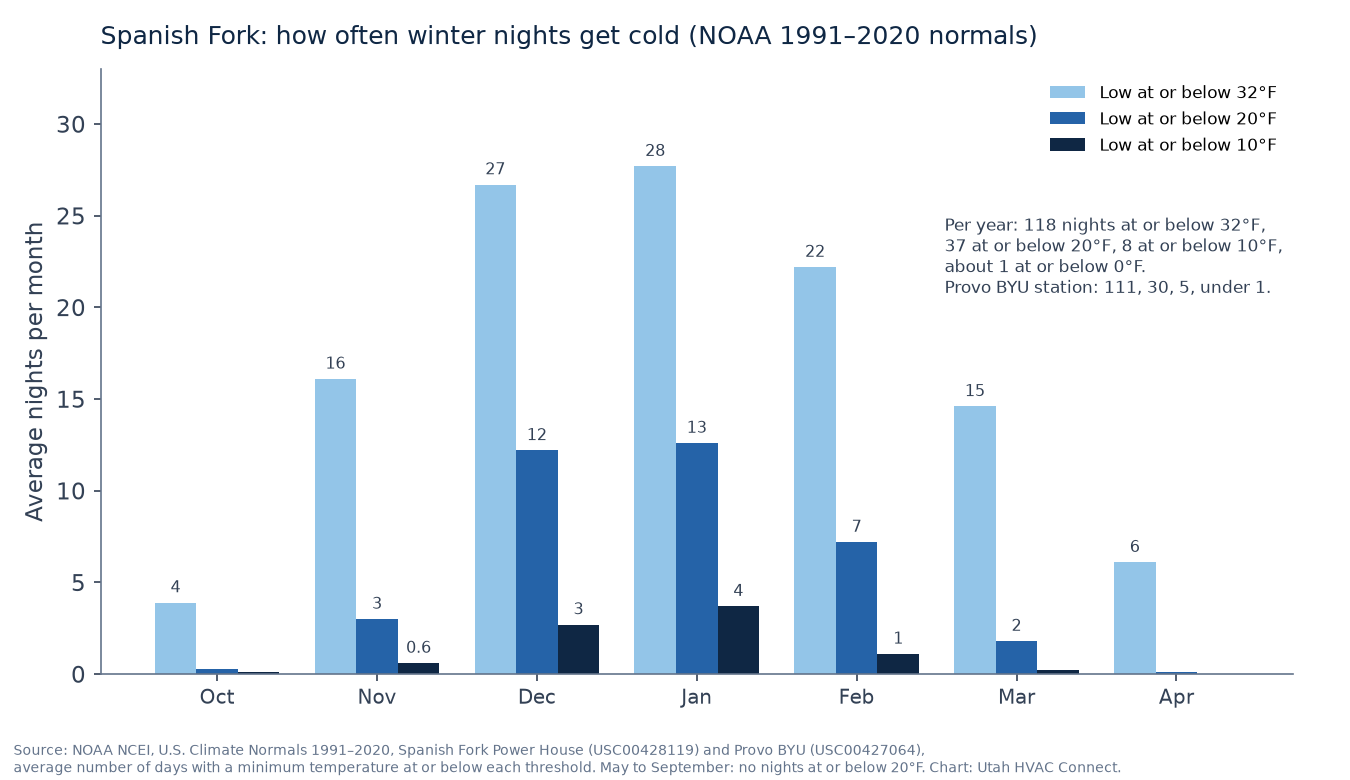
NOAA’s normals station in Spanish Fork averages 118 nights a year with a low at or below freezing, 37 at or below 20°F, and about 8 at or below 10°F. January is the coldest month, with about 27.7 freezing nights and 12.6 nights at or below 20°F (NOAA monthly normals). That’s a little colder than the Provo BYU station:
| Station | Low at or below 32°F | At or below 20°F | At or below 10°F | At or below 0°F |
|---|---|---|---|---|
| Spanish Fork Power House | 118.0 | 37.3 | 8.4 | 1.2 |
| Provo BYU | 111.2 | 30.2 | 4.6 | 0.5 |
Source: NOAA NCEI, 1991–2020 annual normals (days with a minimum temperature at or below each threshold, per the normals documentation). Springville has no normals station.
Where dual fuel fits
A dual-fuel system pairs a heat pump with a gas furnace: the heat pump heats in milder weather and the furnace takes over when it gets cold. Enbridge Gas’s ThermWise rebate for dual fuel requires a changeover setpoint of 40°F or lower, an ENERGY STAR certified ducted heat pump, and an ENERGY STAR certified gas furnace of at least 95% AFUE (97.5% for Tier 2) (ThermWise). With 118 freezing nights a year in Spanish Fork, the furnace still carries the coldest hours under that kind of setup; the heat pump covers the milder ones. How the switch works is explained on our AC and heat pump page.
Why it comes up with a 25-year-old system: the furnace and AC are often due at the same time, so the choice isn’t only “which furnace.” It can be furnace-only, furnace plus a new AC, or furnace plus a heat pump. When we checked on November 9, 2026, ThermWise listed these dual-fuel rebates in Utah:
- Tier 1: $1,000 with a newly installed gas furnace, or $700 where qualifying gas backup is already installed.
- Tier 2 (higher heat pump and furnace ratings): $1,200 with a newly installed furnace, or $850 with existing gas backup (ThermWise).
One planning point from those rules: if you replace only the furnace now, a 95%-plus ENERGY STAR furnace keeps the “existing gas backup” tier open for a heat pump later. Ask your bidder whether the model they propose would qualify.
Utility check for south Utah County. Rocky Mountain Power’s Wattsmart dual-fuel rebate requires Rocky Mountain Power electricity (Wattsmart), and both Spanish Fork and Springville run their own power utilities, so it likely doesn’t apply. ThermWise applies only if Enbridge Gas is your gas utility. Springville’s power site points to UAMPS Smart Energy, where participation varies by city. Details and phone numbers are in the utilities section of our Spanish Fork and Springville page.
If you’re comparing cold-weather heat pump models, NEEP keeps a public list of cold-climate heat pump specifications (NEEP). Ask the bidder how much heat the proposed model delivers at low outdoor temperatures and what changeover temperature they recommend.
Repair or replace: questions for a 2001-era system
- What failed, and is it a safety issue? A cracked heat exchanger is the big one. Ask the technician to show you.
- Is it condensing or non-condensing, and what would a replacement do to the venting?
- How old is the AC, and what refrigerant does it use? If it’s R-22 and also near the end of its life, ask for bids on the combined options.
- Can I see three paths in writing: furnace-only, furnace plus AC, and dual fuel, each with model numbers?
- Which rebates fit my utilities, and who files them?
- Is the permit in the bid? Spanish Fork requires a permit for HVAC equipment, and Springville’s Building Division schedules inspections (see permits).
What moves a replacement bid up or down is in our furnace replacement guide. We don’t publish prices. Heat out right now? Start with no-heat help.
Check the license before work starts
Before anyone works on your system, look the company up on DOPL’s free Licensee Lookup & Verification. You want an Active status and an HVAC classification (H100, or the older S350), under the same business name that’s on your estimate. Step-by-step: how to check a Utah HVAC license.
How matching works
- Tell us what you need on the free Get Help form: service type (Replace, Repair, or “I’m not sure”), urgency (Today, This week, or Planning), your ZIP, and when it’s reasonable to reach you.
- We match licensed Utah shops that serve your ZIP. We don’t dispatch technicians, diagnose, or write proposals.
- Matched pros may reach out using the contact details you provide. You talk with them, compare, and hire who you want, or no one. No homeowner fee and no obligation. More: how it works and how we make money.
Related guides
- Furnace and AC help in Spanish Fork & Springville: housing data, city power, and permits
- Furnace replacement in Utah: repair or replace, rebates, and what drives a bid
- Original furnace in a 1990s–2001 home: repair or replace?: ENERGY STAR’s checklist and venting
- AC and heat pump replacement in Utah: AC-only, dual fuel, or all-electric
- What drives furnace replacement cost in American Fork and Pleasant Grove (no prices)
- Provo heat pump rebate: the UMPA-city rebate that only Provo offers today
How we put this page together
This page was written by the Utah HVAC Connect editorial team, not by a contractor. We used public data only: NOAA 1991–2020 climate normals, U.S. Census Bureau American Community Survey (ACS) estimates, and the rebate, permit, and licensing pages published by Utah utilities, cities, and DOPL, each checked on the date shown above. For this article we read the current federal furnace standard in the eCFR and DOE’s rulemaking page, pulled NOAA’s cold-night normals for the Spanish Fork and Provo stations, and read the ThermWise, Wattsmart, EPA, and ENERGY STAR pages cited. Local housing and utility facts come from our Spanish Fork and Springville page. We don’t publish prices we can’t source, contractors can’t pay to be mentioned here, and we don’t name partner shops on this page. Programs and rules change, so confirm details with the program or your contractor before you sign anything. See our editorial policy. Spot an error? Email hello@utahhvacconnect.com.
Sources
- eCFR, 10 CFR 430.32, Energy and water conservation standards (furnaces, paragraph (e))
- Federal Register, Energy Conservation Standards for Consumer Furnaces (December 18, 2023)
- U.S. DOE, Consumer Furnaces
- NOAA NCEI, 1991–2020 annual normals, Spanish Fork Power House (USC00428119) and Provo BYU (USC00427064), cold-night counts
- NOAA NCEI, 1991–2020 monthly normals, Spanish Fork Power House, cold-night counts
- NOAA NCEI, U.S. Climate Normals monthly documentation (PDF)
- Enbridge Gas, ThermWise appliance rebates
- Rocky Mountain Power, Wattsmart dual fuel heat pumps (UT)
- U.S. EPA, Phaseout of Class II ozone-depleting substances
- ENERGY STAR, Heating and cooling: when to replace
- NREL, ResStock technical documentation for DOE (venting of condensing and non-condensing furnaces)
- Lennox, EL195NE homeowner manual (PDF)
- American Standard, furnace lifespan
- NEEP, Cold Climate Air Source Heat Pump list
- Utah DOPL, Licensee Lookup & Verification
Questions about the service: hello@utahhvacconnect.com.
FAQ
Should I replace a 20-year-old furnace in Spanish Fork?
We can’t make that call; a licensed technician who sees it can. ENERGY STAR suggests considering replacement once a furnace is over 15 years old, and furnace makers commonly cite 15 to 20 years. Safety, repair history, and whether the AC is due too matter as much as age.
What efficiency is a furnace from around 2001?
Federal rules then required at least 78% AFUE for most gas furnaces, so it could be a non-condensing model near that level or a 90%-plus condensing model. Plastic intake and exhaust pipes usually mean condensing; a metal flue usually means non-condensing. The model number on the nameplate tells a technician which.
Will I have to replace my furnace because of the 2028 rule?
No. As codified today, the 95% AFUE minimum applies to non-weatherized gas furnaces manufactured on and after December 18, 2028. It doesn’t require replacing a working furnace. DOE says planned dates can change.
Does dual fuel make sense in Spanish Fork’s winters?
It’s one option to price. NOAA normals show about 118 nights a year at or below freezing in Spanish Fork, so the gas furnace still handles the coldest hours. ThermWise’s dual-fuel rebate requires the system to switch to the furnace at 40°F or lower.
Can I get the Wattsmart dual-fuel rebate in Spanish Fork or Springville?
Probably not. Wattsmart requires Rocky Mountain Power electricity, and both cities run their own power utilities. ThermWise rebates apply if Enbridge Gas is your gas utility. Check both bills.
Is my 2001 AC using R-22?
It may be. The refrigerant is listed on the outdoor unit’s nameplate. EPA ended production and import of R-22 in 2020, which matters if a repair needs refrigerant.
Do you send a technician or give prices?
No. We’re a matchmaker: we connect homeowners with licensed Utah HVAC shops that serve their ZIP. We don’t dispatch, diagnose, or quote. The request is free, with no obligation to hire.