TL;DR
- West Valley City has about 139,129 residents and Taylorsville about 58,487 (UPC 2025). Both are roughly flat since 2020.
- Median home built: 1985 in West Valley City, 1982 in Taylorsville. About 59% of Taylorsville’s units date to the 1970s and 1980s (ACS 2020–2024).
- The Salt Lake City airport station averages a 24.2°F January low and about 1,420 cooling degree days, the most of any station on our pages.
- West Valley City requires a permit to install, replace, or repair a furnace or AC, and allows video inspections for both. Taylorsville usually issues furnace permits without review.
- Wattsmart’s dual-fuel rebate excludes manufactured homes (about 7% of West Valley City units). Free request; matching depends on licensed shops that serve your ZIP.
West Valley City is Utah’s second-largest city, with about 139,129 residents in 2025, and its neighbor Taylorsville has about 58,487. Unlike the fast-growing cities on our other pages, both are roughly flat: West Valley City is down about 0.8% and Taylorsville about 3.2% from April 2020, even though both added housing units, about 2,200 in West Valley City and about 565 in Taylorsville (Utah Population Committee 2025 estimates). What that means for heating and cooling: most homes here are past their first furnace, and a lot of the work is replacement in established houses.
Utah HVAC Connect is a matchmaker under Apex Lead Group, LLC. We connect homeowners with licensed Utah HVAC contractors; we’re not a contractor, and we don’t dispatch, diagnose, or quote. We don’t name or vouch for any particular shop on this page, and we can’t promise a match in every ZIP: matching depends on licensed shops that serve your ZIP.
Housing data
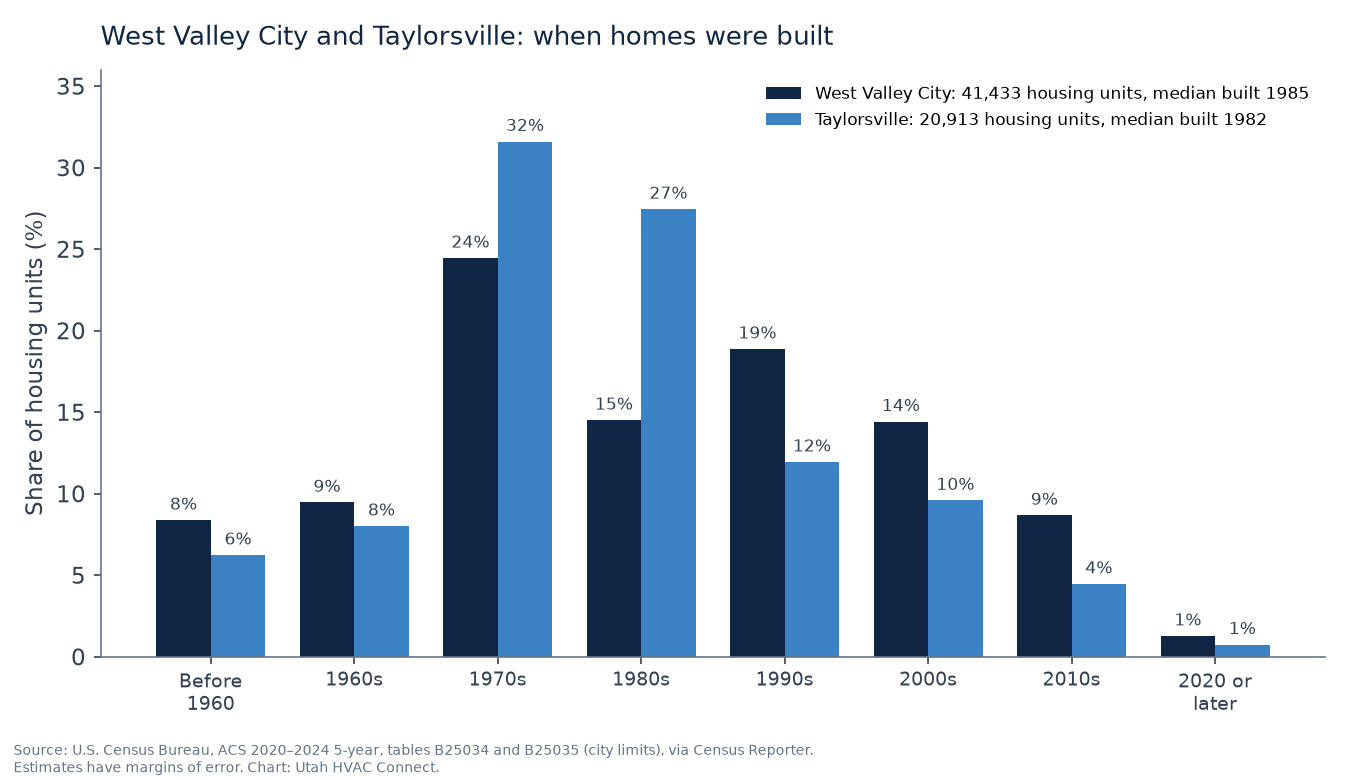
The 1970s were the biggest building decade in both cities: 24% of West Valley City’s housing units and 32% of Taylorsville’s. Taylorsville is the more concentrated of the two. About 59% of its units were built in the 1970s and 1980s, and about 73% before 1990. West Valley City is more spread out: about 57% before 1990, with a second wave in the 1990s (19%) and 2000s (14%). Both are about 71–72% owner-occupied, and about 84–86% of occupied homes heat with utility gas (ACS tables B25034, B25035, B25003, B25040).
| Area | Housing units | Median year built | Owner-occupied | Heat with utility gas | Heat with electricity |
|---|---|---|---|---|---|
| West Valley City (city limits) | 41,433 | 1985 | 72% | 86% | 12% |
| Taylorsville (city limits) | 20,913 | 1982 | 71% | 84% | 14% |
| ZIP 84120 | 14,316 | 1978 | 76% | 88% | 9% |
| ZIP 84119 | 17,080 | 1985 | 57% | 82% | 15% |
| ZIP 84128 | 8,599 | 1993 | 88% | 89% | 8% |
| ZIP 84118 | 12,466 | 1979 | 84% | 89% | 9% |
| ZIP 84129 | 12,234 | 1982 | 80% | 89% | 10% |
| ZIP 84123 | 15,082 | 1984 | 59% | 77% | 21% |
Source: U.S. Census Bureau, ACS 2020–2024 5-year estimates (tables B25034, B25035, B25003, B25040), via Census Reporter. Owner-occupied and heating fuel are shares of occupied homes; year built is of all housing units. ZIP rows cover the whole ZIP, including parts outside these two cities. Estimates have margins of error.
Which ZIP am I in? By land area in the Census Bureau’s 2020 ZIP-to-place relationship file, nearly all of 84120 (99.7%) is inside West Valley City, along with most of 84128 (83%), 84119 (79%), and 84118 (61%). For Taylorsville, 84129 is almost entirely in the city (98%), and about half of 84123 is (49%); the rest of those ZIPs lies in neighboring areas (Census relationship file). That’s why we show city-limit numbers first. Enter your own ZIP on the form.
Home types: about two-thirds of housing units in both cities are single-family detached. Manufactured homes are a bigger share here than on most of our pages: about 7% of West Valley City’s units and 4% of Taylorsville’s, and about 10% in ZIP 84119 (ACS table B25024). That matters for rebates (see below).
What the numbers suggest
General context, not a diagnosis of your system:
- 1970s and 1980s homes (39% in West Valley City, 59% in Taylorsville): these houses are about 37 to 56 years old, so the furnace in them is very likely not the first one. Replacing a furnace in a house this age raises venting, chimney-liner, sizing, and ductwork questions. See replacing the furnace in a 1970s–80s home and our furnace replacement guide.
- 1990s and 2000s homes (33% in West Valley City, 22% in Taylorsville): an original furnace from this era is at or past the 15-to-20-year lifespan furnace makers commonly cite (American Standard). See 20-year-old furnace: repair or replace?
- Electric heat: about 21% of occupied homes in ZIP 84123 heat with electricity, the highest share among these ZIPs. If you’re weighing a heat pump, see AC and heat pump replacement.
- Renters: about 28–29% of occupied homes in both cities are rented, and 41–43% in ZIPs 84119 and 84123. If you rent, the landlord or property manager approves HVAC work; our request form is for the person who can approve it.
If heat is out right now, start with no-heat help. If the furnace runs but blows cold air, see furnace blowing cold air.
Winter and summer at the nearest normals station
The closest long-record NOAA normals station is Salt Lake City International Airport. Its 1991–2020 normals show about 5,154 heating degree days a year, with 1,041 in January and 1,018 in December, and an average January low of 24.2°F. It averages about 112 nights a year at or below freezing, 32 at or below 20°F, and 6 at or below 10°F (NOAA annual normals; monthly). Summers are the hottest of any station on our pages: about 1,420 cooling degree days, with July alone at 500. For comparison, the Provo BYU station shows about 1,205 and Spanish Fork about 1,013 (NOAA, Provo BYU; Spanish Fork). In practice, an aging AC works hard here in July and August, and the furnace still carries a full winter. The airport isn’t in either city, so treat these numbers as a valley-wide guide.
Power, gas, and rebates
- Electric: we didn’t find a city-run electric utility for either city, unlike Lehi, Provo, or Spanish Fork. Rocky Mountain Power’s service-area map labels West Valley City inside its Wasatch Front service area (Rocky Mountain Power service area map). Check the name on your electric bill before you count on a Wattsmart rebate.
- Wattsmart dual fuel: for Rocky Mountain Power customers, Wattsmart lists a dual-fuel heat pump rebate of $1,450 for an AHRI-rated matched system or $700 otherwise. It requires an existing single-family home and a program-participating contractor, and manufactured homes don’t qualify (Wattsmart dual fuel heat pumps). Our dual-fuel rebate guide walks through how the two programs fit together.
- Gas: if your gas bill is from Enbridge Gas, ThermWise lists rebates of $300 for a 95%–97.4% AFUE furnace and $350 for 97.5% or higher with an ECM, plus dual-fuel tiers. Requests must be postmarked within six months of installation (ThermWise, as listed November 16, 2026).
- Federal: the 25C tax credit isn’t allowed for equipment placed in service after December 31, 2025 (IRS).
Permits
- West Valley City: the Building Inspection Division’s permit list includes “installing, replacing or repairing a furnace, water heater, boiler, air conditioner, evaporative cooler, heat pump, or baseboard heating equipment” for single-family homes, and the permit is purchased from the division (West Valley City permit requirements). The city says inspection requests can usually be accommodated within 24 hours (WVC Building Inspections). Furnace Replacement and A/C Change Out are on its Residential Video Inspection Program list: an inspector video-calls the installer by FaceTime or Google Duo, and the request goes to 801-963-3283 at least one hour ahead. If a video inspection can’t be completed, the city says it will try to send a field inspector the same day, or schedule one for the next business day (WVC video inspections).
- Taylorsville: the Building Department says furnaces and water heaters “can usually be issued without review.” Inspections are scheduled through the city’s online portal with at least 24 hours’ notice, run 9 a.m. to 4 p.m. on weekdays, and an adult must be present for an inspector to enter an occupied home (Taylorsville Building Department FAQ).
Most homeowners have the contractor pull the permit. Ask whether it’s included in the bid, who requests the inspection, and, in West Valley City, whether the installer plans to use a video inspection. We don’t publish permit fees for these two cities because we couldn’t confirm them on an official fee page; ask the city or your contractor.
Check the license before work starts
Before anyone works on your system, look the company up on DOPL’s free Licensee Lookup & Verification. You want an Active status and an HVAC classification (H100, or the older S350), under the same business name that’s on your estimate. Step-by-step: how to check a Utah HVAC license.
How matching works
- Tell us what you need on the free Get Help form: service type (Repair, Replace, Install, Tune-up, or “I’m not sure”), urgency (Today, This week, or Planning), your ZIP, and when it’s reasonable to reach you.
- We match licensed Utah shops that serve your ZIP. We don’t dispatch technicians, diagnose, or write proposals.
- Matched pros may reach out using the contact details you provide. You talk with them, compare, and hire who you want, or no one. No homeowner fee and no obligation. More: how it works and how we make money.
Related guides
- Furnace replacement in Utah: repair-or-replace questions, rebates, permits
- Furnace not working? No-heat help in Utah: safety first, basic checks
- West Jordan & South Jordan: local data for the cities just south
- AC and heat pump replacement in Utah: AC-only, dual fuel, or all-electric
- Replacing the furnace in a 1970s–80s home: venting, liners, and sizing
- Inversion season: furnace filters and airflow
- Dual-fuel heat pump rebates: Wattsmart and ThermWise: which lines your furnace can fit
How we put this page together
This page was written by the Utah HVAC Connect editorial team, not by a contractor. We used public data only: NOAA 1991–2020 climate normals, U.S. Census Bureau American Community Survey (ACS) estimates, and the rebate, permit, and licensing pages published by Utah utilities, cities, and DOPL, each checked on the date shown above. For this page we pulled city- and ZIP-level housing data for West Valley City and Taylorsville, checked how the ZIPs line up with city limits using Census geography files, used NOAA’s Salt Lake City airport normals as the nearest long-record station, and read both cities’ building pages plus the Wattsmart and ThermWise rebate pages. We don’t publish prices we can’t source, contractors can’t pay to be mentioned here, and we don’t name partner shops on this page. Programs and rules change, so confirm details with the program or your contractor before you sign anything. See our editorial policy. Spot an error? Email hello@utahhvacconnect.com.
Sources
- U.S. Census Bureau, ACS 2020–2024 5-year, tables B25034, B25035, B25003, B25040, B25024, West Valley City and Taylorsville cities and ZCTAs 84118, 84119, 84120, 84123, 84128, 84129, via Census Reporter API
- U.S. Census Bureau, 2020 ZCTA-to-place relationship file
- Kem C. Gardner Policy Institute / Utah Population Committee, 2025 subcounty dataset (CSV, April 2020 base through July 2025)
- NOAA NCEI, 1991–2020 annual normals, Salt Lake City International Airport (USW00024127)
- NOAA NCEI, 1991–2020 monthly normals, Salt Lake City International Airport
- NOAA NCEI, 1991–2020 annual normals, Provo BYU (USC00427064)
- NOAA NCEI, 1991–2020 annual normals, Spanish Fork Power House (USC00428119)
- Rocky Mountain Power, service area map (PDF)
- Rocky Mountain Power, Wattsmart dual fuel heat pumps (UT)
- Enbridge Gas, ThermWise appliance rebates
- IRS, FAQs on 25C under Public Law 119-21
- West Valley City, Building Inspections, Permit requirements
- West Valley City, Building Inspections
- West Valley City, Residential Video Inspection Program
- Taylorsville City, FAQ (Building Department)
- American Standard, furnace lifespan
- Utah DOPL, Licensee Lookup & Verification
Questions about the service: hello@utahhvacconnect.com.
FAQ
Do you cover West Valley City and Taylorsville?
You can send a free request from any West Valley City or Taylorsville ZIP. Matching depends on licensed Utah HVAC shops that serve your ZIP, so we can’t promise a match for every address, and we don’t name or vouch for particular shops. If a match is made, those pros may reach out.
How old are homes in West Valley City and Taylorsville?
The median home was built in 1985 in West Valley City and 1982 in Taylorsville (ACS 2020–2024). The 1970s were the biggest building decade in both, and about 73% of Taylorsville’s housing units predate 1990.
Do I need a permit to replace a furnace or AC in West Valley City?
Yes. West Valley City’s permit list includes installing, replacing, or repairing a furnace, air conditioner, heat pump, and similar equipment in single-family homes. Furnace replacements and AC change-outs can use the city’s video inspection program.
Do I need a permit to replace a furnace in Taylorsville?
Taylorsville’s Building Department says furnace and water heater permits can usually be issued without plan review, and inspections are scheduled through its online portal with 24 hours’ notice. Most homeowners have the contractor pull the permit.
Can I get a Wattsmart rebate on a manufactured home?
Not the dual-fuel heat pump rebate: Wattsmart’s page says manufactured homes don’t qualify. About 7% of West Valley City’s housing units are manufactured homes (ACS). Ask the program about other options.
How cold and hot does it get here?
At the Salt Lake City airport station, NOAA’s 1991–2020 normals show an average January low of 24.2°F, about 5,154 heating degree days, and about 1,420 cooling degree days a year, more cooling than the Provo or Spanish Fork stations.
Is the request free, and do you send the technician?
The request is free for homeowners with no obligation to hire. We don’t send technicians or quote; we’re a matchmaker that connects you with licensed Utah HVAC shops that serve your ZIP.